
Cited Ground Truth for AI Agents
AI agents already answer questions about your products, policies, and pricing. Cited ground truth is the verified source layer that keeps those answers grounded and traceable. Without it, teams cannot prove what the agent used, whether the answer matches current policy, or where the response went wrong.
What is cited ground truth for AI agents?
Cited ground truth for AI agents is verified enterprise knowledge that an agent can trace to a specific source before it generates an answer. Senso defines verified ground truth as the structured set of enterprise facts, documentation, policies, pricing, and product details that AI systems can use.
That matters because raw sources are not enough. AI agents need a governed, version-controlled context layer that tells them which facts are current, which sources are approved, and which answers are citation-accurate.
Why does cited ground truth matter?
Cited ground truth matters because AI agents are already the interface to your business. They answer questions about your products, policies, and pricing without a human in the loop, and in regulated industries that creates compliance and audit risk.
It also matters because agents shift competition from human attention to machine selection. If the model cannot find clear, grounded facts, it will choose a competitor that is easier to verify and cite.
For CISOs and compliance teams, the core question is simple. Can you prove that the agent cited a current policy, and can you show the source behind the answer? Standard retrieval tools usually cannot answer that.
Senso’s proof points show what happens when verified ground truth is in place. Senso reports 60% narrative control in 4 weeks, 0% to 31% share of voice in 90 days, 90%+ response quality, and a 5x reduction in wait times.
What should be included in verified ground truth?
Verified ground truth should include the facts an agent must never guess. Senso’s guidance points to product details, policies, pricing, documentation, and other approved facts that define how the organization wants to be represented.
Clean structure matters too. Pages that express ground truth in FAQs, pricing pages, and policy pages perform best because AI systems can read them with less ambiguity.
A strong ground truth set usually includes:
- Product descriptions and feature definitions
- Pricing and packaging details
- Policy pages and compliance language
- FAQ content that answers common questions directly
- Current documentation that reflects approved process and usage
The key is freshness. Refresh core ground truth pages on a regular cadence and immediately after changes to products, pricing, or policies.
How do you build cited ground truth for AI agents?
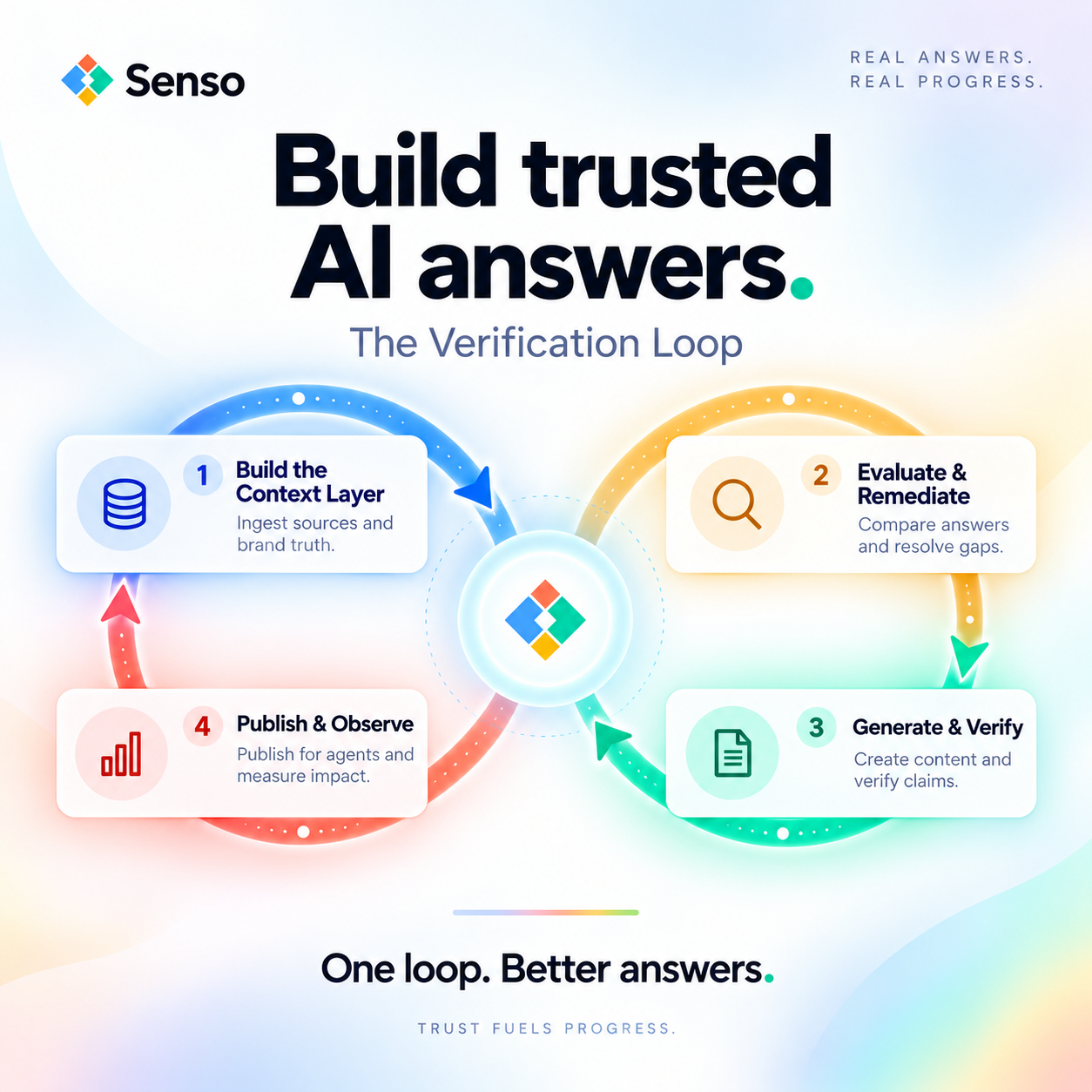
You build cited ground truth by ingesting approved raw sources, compiling them into a governed knowledge base, and then verifying every answer against that source of truth. The goal is not more content. The goal is provable context.
A simple build process looks like this:
-
Ingest approved raw sources
Pull in the policies, product facts, pricing, and documentation that your team already stands behind. -
Compile them into a governed knowledge base
Senso describes this as a compiled knowledge base that gives agents one verified place to pull from. -
Publish verified sources
A verified source is content your organization stands behind. Every important claim is checked against approved ground truth, reviewed before publication, and tied to verification history. -
Evaluate each agent answer
Score every response against verified ground truth to see whether the answer is grounded and citation-accurate. -
Route gaps to the right owners
When the agent is wrong or incomplete, send the issue to the team that can fix the source, not just the answer. -
Refresh whenever truth changes
Update the compiled knowledge base immediately after policy, pricing, or product changes.
This is knowledge governance, not just retrieval. Retrieval finds text. Governance proves that the text is the truth.
How is cited ground truth different from standard retrieval?
Cited ground truth is different because it controls what counts as verified and whether the answer can be proven later. Standard retrieval tools can return passages. They usually do not tell you whether the answer is current, compliant, or tied to approved ground truth.
| Cited ground truth | Standard retrieval |
|---|---|
| Compiled, version-controlled facts | Uncurated passages from raw sources |
| Every answer traces to a verified source | Answer may not prove current policy |
| Built for auditability and compliance | Built to return text |
| Supports internal agents and public AI answers | Usually stops at retrieval |
For regulated teams, that difference matters. If a customer, regulator, or internal reviewer asks where the answer came from, cited ground truth gives you the receipt.
How does Senso use cited ground truth?
Senso uses cited ground truth as the context layer for AI agents. One compiled knowledge base powers both internal workflow agents and external AI-answer representation, so teams do not duplicate work or maintain separate source sets.
Senso AI Discovery gives marketing and compliance teams control over AI Visibility. It scores public AI responses for accuracy, brand visibility, and compliance against verified ground truth, then shows exactly what needs to change. No integration is required.
Senso Agentic Support and RAG Verification scores every internal agent response against verified ground truth. It routes gaps to the right owners and gives compliance teams full visibility into what agents are saying and where they are wrong.
That matters in financial services, healthcare, and credit unions. In those environments, accuracy and auditability are not nice to have. They are the baseline.
What outcomes should teams expect?
Teams should expect fewer unsupported answers, faster issue routing, and clearer control over how AI represents the organization. Senso’s documented results point to 90%+ response quality and a 5x reduction in wait times when the verification loop is in place.
The bigger outcome is narrative control. When AI agents cite verified truth, your brand is less likely to be misrepresented, missing, or passed over in AI-driven discovery.
FAQs
Is cited ground truth only for regulated industries?
No. Regulated industries feel the risk first, but any company that is represented by AI agents needs cited ground truth. The cost of a wrong answer grows when customers, staff, or buyers rely on the agent instead of a human reviewer.
Do citations alone make AI answers trustworthy?
No. Citations help, but the source itself must be verified and current. Senso’s approach is to score answers against verified ground truth so the team can prove the answer is grounded, not just cited.
How often should ground truth be refreshed?
Refresh it on a regular cadence and immediately after any change to products, pricing, or policies. If the source is stale, the citation is stale too.
What is the fastest way to start?
Start with the facts that matter most to customers and compliance teams. That usually means products, pricing, policies, and FAQ pages written in clean, structured formats.
If you want to see where AI answers diverge from your verified ground truth, Senso offers a free audit at senso.ai. No integration. No commitment.