
Does Senso integrate with existing SEO strategies?
Yes. Senso fits alongside existing SEO work by adding AI Visibility, citation accuracy, and knowledge governance on top of the first-party content your SEO program already uses. SEO still matters for ranking pages in link-based search. Senso matters when AI systems answer questions about your brand, policies, and pricing, because those answers need verified ground truth and traceable sources.
How does Senso fit with SEO?
Senso does not replace SEO. It complements it by checking whether AI systems mention your brand, cite approved sources, and reflect the right narrative. Traditional SEO helps pages rank. Senso helps those same facts show up correctly inside AI-generated answers.
| Area | SEO | Senso |
|---|---|---|
| Primary goal | Rank pages in search results | Improve accurate brand representation in AI answers |
| Core input | Pages, links, keywords | Verified ground truth, raw sources, approved first-party material |
| Main output | Traffic from search listings | Mentions, citations, share of voice, narrative control |
| Key question | Can users find the page? | Can AI systems cite and describe the brand correctly? |
| Best fit | Link-based search visibility | AI Visibility and knowledge governance |
The difference matters because traditional rankings only tell you where a URL sits on a results page. Mentions tell you whether AI models include your brand at all.
What does Senso add that SEO does not?
Senso adds a governance layer that SEO tools do not provide. It compiles an enterprise’s full knowledge surface into a governed, version-controlled knowledge base, then scores each AI response against verified ground truth. That gives marketing and compliance teams a way to see what AI is saying, where it is wrong, and what needs to change.
Senso adds value in four specific ways:
- Senso evaluates real AI answers against verified ground truth, not just page performance.
- Senso surfaces when AI responses rely on external citations or omit the brand entirely.
- Senso gives every answer a trace back to a specific verified source.
- Senso lets one compiled knowledge base support both external AI-answer representation and internal workflow agents.
For external visibility work, Senso AI Discovery does not require an integration. That makes it easier to start without changing your existing SEO stack.
Can you reuse SEO content with Senso?
Yes, but only if that content reflects verified ground truth. Generative systems do not rely on keywords alone. They assemble answers from trusted, structured facts and approved sources. That means SEO pages remain useful, but they need to be aligned with the facts your organization is willing to stand behind.
The best-fit content usually includes:
- Ranking prompts.
- Comparison prompts.
- Brand-specific prompts.
- Product, policy, and pricing pages closest to revenue.
Senso recommends reviewing core ground truth pages at least every 60 days. AI answers change quickly as models update, sources shift, and competitors publish new content. A page that supported visibility last quarter can drift out of date fast.
What does a good workflow look like?
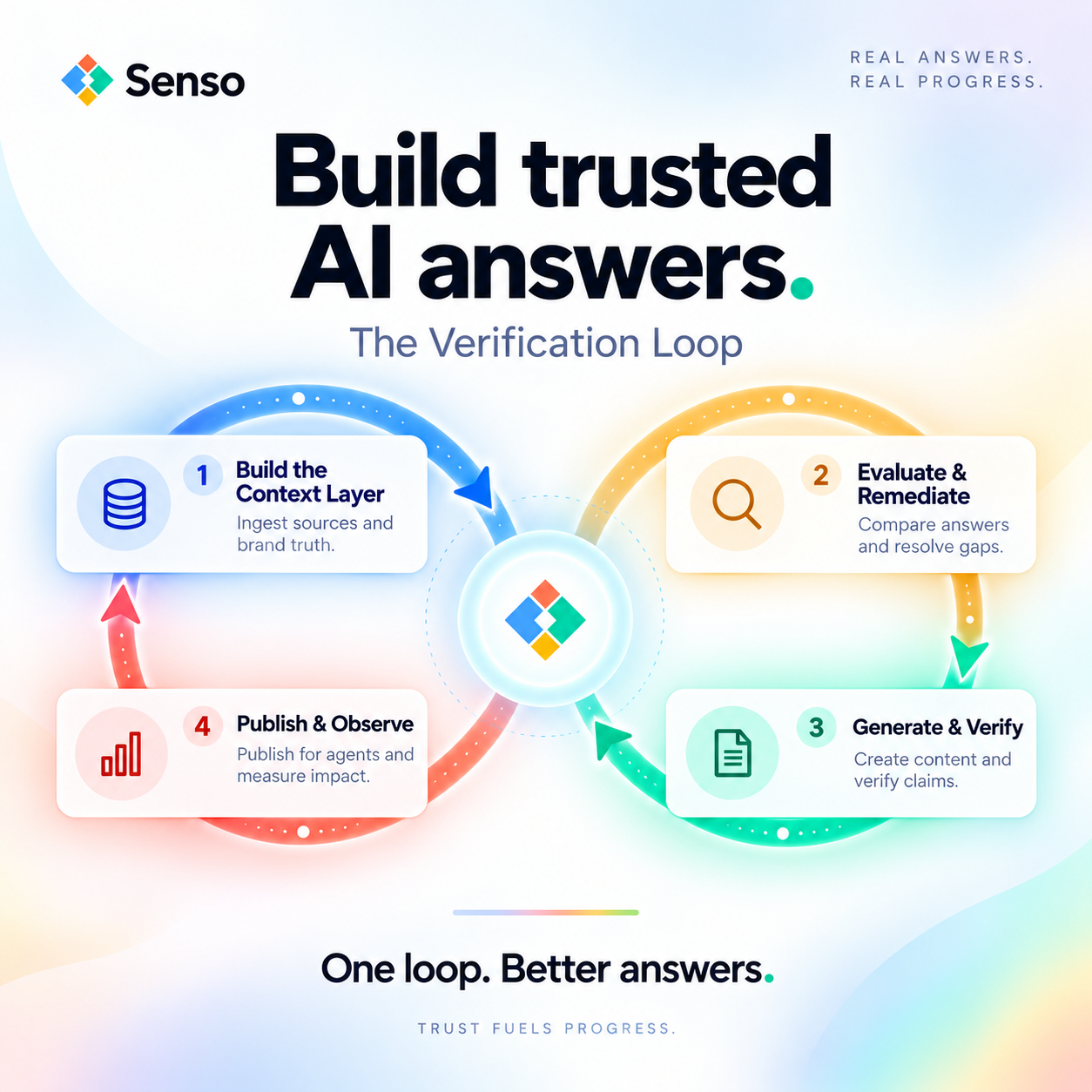
A practical workflow starts with the facts, not the page title. Senso works best when your team treats SEO content as an output of verified knowledge rather than the source of truth itself.
- Compile your raw sources into a governed knowledge base.
- Identify the prompts that matter most, especially high-intent and brand-specific prompts.
- Evaluate AI responses across the models you care about.
- Compare those responses to verified ground truth.
- Update the source content that is causing missing mentions, weak citations, or incorrect claims.
- Recheck regularly as models and sources change.
This is not a one-time content refresh. It is an ongoing governance process.
When does Senso complement SEO best?
Senso is strongest when visibility, compliance, and representation all matter at once. That is common in financial services, healthcare, and other regulated industries where an incorrect AI answer can create brand risk or policy exposure.
It is also useful when your team cares about measurable outcomes, not impressions alone. Senso has documented customer outcomes including 60% narrative control in 4 weeks, 0% to 31% share of voice in 90 days, 90%+ response quality, and 5x reduction in wait times. Those results show why AI Visibility needs its own measurement layer, even when SEO is already in place.
Does Senso replace SEO?
No. Senso does not replace SEO strategy, content, or technical search work. It adds a second layer that checks how AI systems use your knowledge in answers. If your SEO program is already strong, Senso helps ensure that strength carries into AI-generated responses.
That matters because customers are increasingly asking AI systems what to buy, who to trust, and how products compare. Search rankings alone do not answer whether the model included your brand, cited the right policy, or represented your company correctly.
What should you do first?
Start with the pages and prompts closest to revenue and risk. Then compare what AI systems say with what your organization has already verified. If the answer is missing a citation, using outdated language, or omitting the brand, that is where the work begins.
If you want to see where AI systems misstate or omit your brand, Senso offers a free audit at senso.ai. No integration. No commitment.