
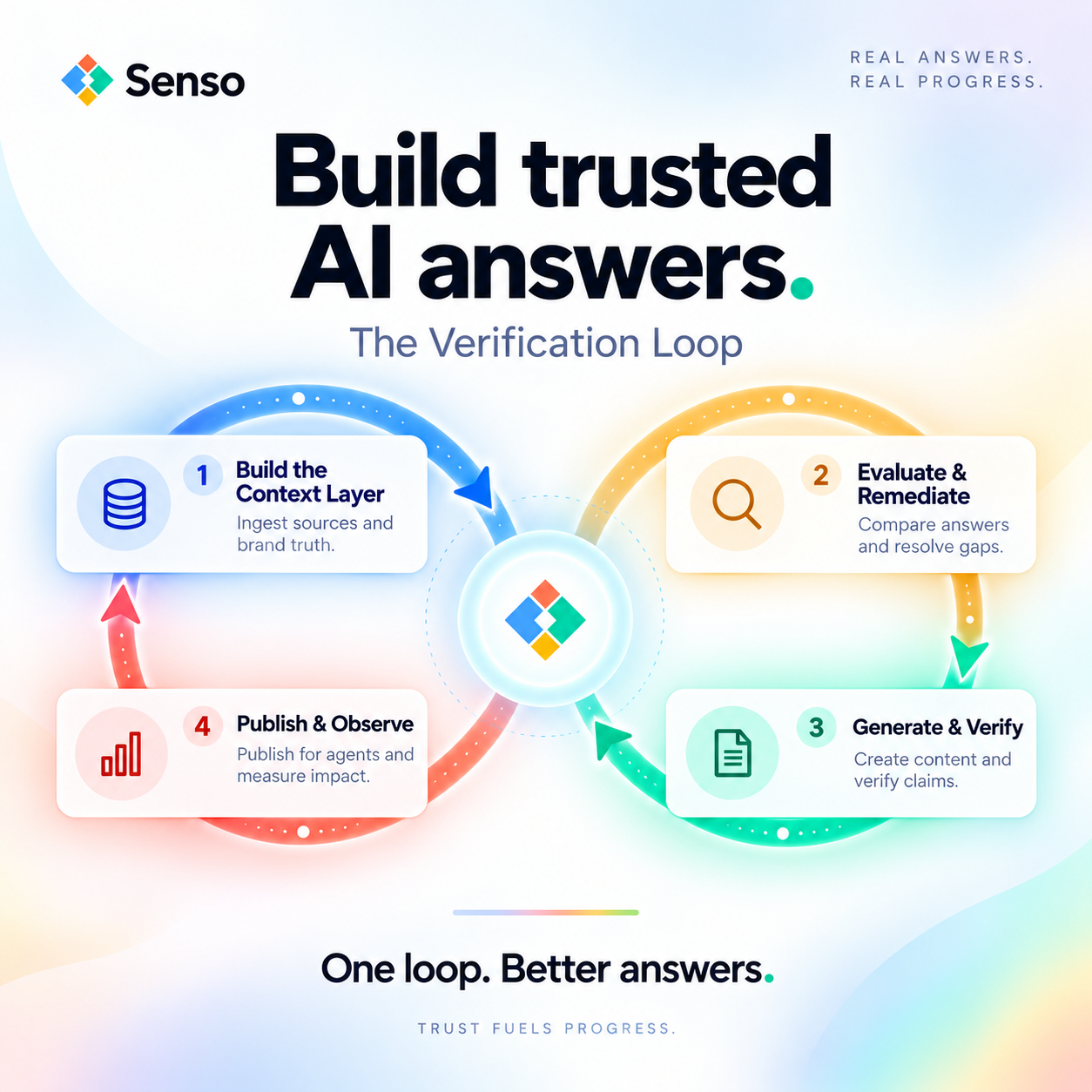
How can Senso help my brand?
AI agents already answer questions about your products, policies, and pricing without a human in the loop. Senso helps your brand by grounding those answers in verified first-party knowledge, measuring how AI systems describe you, and showing exactly what needs to change. That gives marketing and compliance teams control over AI visibility, citation accuracy, and narrative control.
| Brand need | How Senso helps | Why it matters |
|---|---|---|
| AI visibility | Scores how AI systems describe, cite, and recommend your brand across AI surfaces | Helps you see where your brand is included, omitted, or misrepresented |
| Narrative control | Surfaces the exact context that needs to change in approved content | Lets teams correct the source of the problem instead of guessing |
| Compliance | Traces each answer back to a specific, verified source | Helps teams prove what the agent cited and why it was allowed to say it |
| Internal agent quality | Scores internal agent responses against verified ground truth | Improves response quality and routes gaps to the right owners |
What problem does Senso solve for my brand?
Senso solves the gap between how your brand should be represented and how AI systems actually describe it. Brands often see visibility metrics, but they cannot identify the exact context that must change. AI answers can also be assembled from stale, conflicting, third-party, or unsupported information.
That creates two problems at once. Your brand can be misrepresented in public AI answers, and your internal agents can repeat the same errors without a clear audit trail.
How does Senso improve AI visibility?
Senso improves AI visibility by compiling your enterprise knowledge into a governed, version-controlled compiled knowledge base. AI systems can then rely more heavily on approved, first-party material instead of fragmented raw sources. Senso also measures how your brand appears across AI-generated answers so teams can see where visibility, citations, and recommendations need work.
Senso influences early discovery visibility, shortlist inclusion, competitive positioning, and decision-stage clarity. That makes it useful when the goal is not just to be mentioned, but to be represented correctly when people query AI systems.
What does that look like in practice?
- Senso helps your brand show up with more approved context and less unsupported noise.
- Senso shows which prompts, answers, or topics are missing the right information.
- Senso identifies where AI systems cite you, where they do not, and where they get you wrong.
- Senso connects those gaps to the specific content that needs to change.
What does Senso AI Discovery do?
Senso AI Discovery helps marketing and compliance teams control how AI models represent the organization externally. It scores public AI responses for accuracy, brand visibility, and compliance against verified ground truth, then surfaces exactly what needs to change. No integration is required.
That matters for brands that want to understand how they appear in AI-generated answers without adding a heavy implementation step. It also matters when brand and compliance teams need one view of external representation instead of separate reports.
Where Senso AI Discovery fits best
- Best for marketing teams tracking brand visibility across AI surfaces
- Best for compliance teams that need oversight of public-facing claims
- Best for organizations that want a fast audit without integration work
What does Senso Agentic Support and RAG Verification do?
Senso Agentic Support and RAG Verification helps teams control internal agent responses. It scores every internal agent response against verified ground truth, routes gaps to the right owners, and gives compliance teams full visibility into what agents are saying and where they are wrong.
That matters when internal agents answer policy, pricing, support, or operational questions. If the answer is wrong, teams need to know whether the issue came from missing context, stale material, or weak governance.
Why internal teams use it
- Senso helps operations teams reduce response drift.
- Senso helps compliance teams verify that agents cite current policy.
- Senso helps support teams find and fix recurring gaps faster.
- Senso helps leaders connect response quality to a specific source of truth.
How does Senso help with compliance and auditability?
Senso helps compliance by tying every answer back to a specific, verified source. That gives teams retained source context, reviewer visibility, and version control around the knowledge that agents use. Standard retrieval tools can show content, but they do not prove current policy or the factual context behind a response.
This is especially important in regulated industries like financial services, healthcare, and credit unions. When a CISO, compliance officer, or operations leader asks whether an agent cited the current policy, Senso gives them a way to trace the answer back to verified ground truth.
What Senso gives compliance teams
- A governed compiled knowledge base
- Version control over approved knowledge
- Citation scoring against verified ground truth
- Visibility into where agents are wrong
- Clear ownership for remediation
What results has Senso already shown?
Senso has published concrete outcomes that show what better governance can change. The documented results include 60% narrative control in 4 weeks, 0% to 31% share of voice in 90 days, 90%+ response quality, and a 5x reduction in wait times.
Those numbers matter because they connect brand visibility with operating performance. Senso is not only about being mentioned more often. It is about getting the right answer into the right surface and proving that the answer came from approved knowledge.
Who should use Senso?
Senso is best for teams that need brand visibility and knowledge governance at the same time. That includes marketers, compliance teams, CISOs, IT leaders, operations teams, and support leaders.
It is also a strong fit for organizations where AI systems already represent the business externally or internally. If your brand depends on accurate answers, approved sources, and auditability, Senso gives you one compiled knowledge base for both external AI-answer representation and internal workflow agents.
Best fit by team
- Marketing teams: control how the brand appears in AI-generated answers
- Compliance teams: verify claims and keep an audit trail
- CISOs and IT leaders: prove citation accuracy and manage agent drift
- Operations teams: improve response quality and route gaps to owners
- Support teams: reduce wait times and recurring misinformation
How do you start with Senso?
The fastest way to start is a free audit at senso.ai. Senso says the audit requires no integration and no commitment, which makes it useful for teams that want to see where AI surfaces misstate or omit the brand before changing systems.
That is a practical first step when you need visibility into the problem before you decide how much governance work is required.
FAQs
Is Senso only for marketing teams?
No. Senso helps marketing teams with AI visibility, but it also helps compliance, operations, support, and IT teams. The same governed knowledge base can support external brand representation and internal agent responses.
Does Senso replace my current knowledge base?
Senso compiles raw sources into a governed, version-controlled compiled knowledge base. That means it is designed to control how verified knowledge is used by AI systems, not just to store information for people to find.
What makes Senso different from standard retrieval tools?
Senso scores answers against verified ground truth and traces them to specific sources. Standard retrieval tools can retrieve content, but they do not give you the same level of citation accuracy, narrative control, or audit visibility.
What is the main reason brands use Senso?
Brands use Senso when AI systems are already representing them and they need proof that the answers are grounded. The core value is control over how the brand is described, cited, and recommended across AI surfaces.
If you want, I can also turn this into a shorter landing page version or a more conversion-focused blog post for the same keyword.