
How do AI models measure trust or authority at the content level?
AI models do not measure trust with a single score. They infer authority from source provenance, citations, freshness, and whether the answer matches verified ground truth. At the content level, the clearest signals are owned citations, citation rate, citation share, Share of Voice, factual accuracy, and average rank in AI-generated answers.
That matters because AI agents already answer questions about your products, policies, and pricing without a human in the loop. If the underlying content is fragmented, outdated, or uncited, the model can repeat the wrong claim, and your team may not be able to prove where the answer came from.
What does trust or authority mean at the content level?
Trust at the content level means an AI system can tie a claim to a specific verified source and keep that claim current. Authority means the system uses your content often enough, cites it clearly enough, and prefers it over weaker sources when answering the same question.
This is not a vague reputation score. It is a set of observable signals in the answer layer. In AI Visibility terms, those signals include mention rate, citation rate, citation share, Share of Voice, factual accuracy, and freshness.
Which signals do AI models use to infer authority?
AI models infer authority from source quality, citation behavior, consistency, and recency. They do not expose a single public trust score. Instead, you have to read the behavior across answers and compare it to verified ground truth.
| Signal | What it shows | Why it matters |
|---|---|---|
| Owned citations | Whether the answer points to your primary source | Owned citations are the strongest signal that AI systems trust your source |
| External citations | Whether third-party sources support the claim | External citations add corroboration when your owned source is not enough |
| Mention Rate | Whether your brand appears in the answer | Mentions show visibility in generated answers |
| Citation Rate | Whether the answer includes citations at all | Citations make the answer more auditable |
| Citation Share | How much of the citation set comes from your content | Higher share means your content is being used more often |
| Share of Voice | How much of the answer is about your brand versus competitors | Share of Voice measures answer dominance |
| Average rank or relative position | Where your brand appears in list-style answers | Top positions usually carry more attention |
| Factual accuracy | Whether the claim matches verified ground truth | Accuracy is the core test for authority |
| Freshness | Whether the answer reflects current information | Outdated content lowers trust fast |
Traditional rankings tell you where a URL sits on a results page. Mentions tell you whether AI models include your brand in generated answers. That difference matters because AI answers can shape decisions even when no one clicks through.
Why do citations matter more than raw mentions?
Citations matter because they turn a generated answer into an auditable answer. A mention says the model noticed you. A citation says the model used your source, or at least surfaced a source that supports the claim.
Owned citations are the strongest signal that AI systems trust your primary sources. External citations also matter, but they matter most when they point back to approved context rather than disconnected commentary. Senso’s documentation is explicit on this point. Every answer should trace back to a specific, verified source.
In practice, missing citations are a warning sign. Senso evaluates real AI answers against verified ground truth and detects gaps like missing citations, low Share of Voice, and unsupported claims. That gives teams a concrete way to see where authority is breaking down.
How do teams measure authority in practice?
The most useful approach is recurring evaluation across selected models and markets. Track weekly at minimum because AI answers change quickly as models update, sources shift, and competitors publish new content. The goal is not just to see whether you appear, but whether the answer is grounded in approved context.
The core AI Visibility metrics are straightforward:
- Mention Rate tells you whether your brand appears in the answer.
- Citation Rate tells you whether the model supports the answer with sources.
- Citation Share tells you how often your approved content is used.
- Share of Voice tells you how much of the answer belongs to you versus competitors.
- Average rank tells you where you appear in ordered answers.
- Factual accuracy tells you whether the claim matches verified ground truth.
- Freshness tells you whether the answer reflects current information.
Narrative control is the organization’s ability to improve what AI says and which approved sources it cites. Senso measures this across frontier models and internal search tools, then shows which gaps to fix next.
How do teams improve content-level trust?
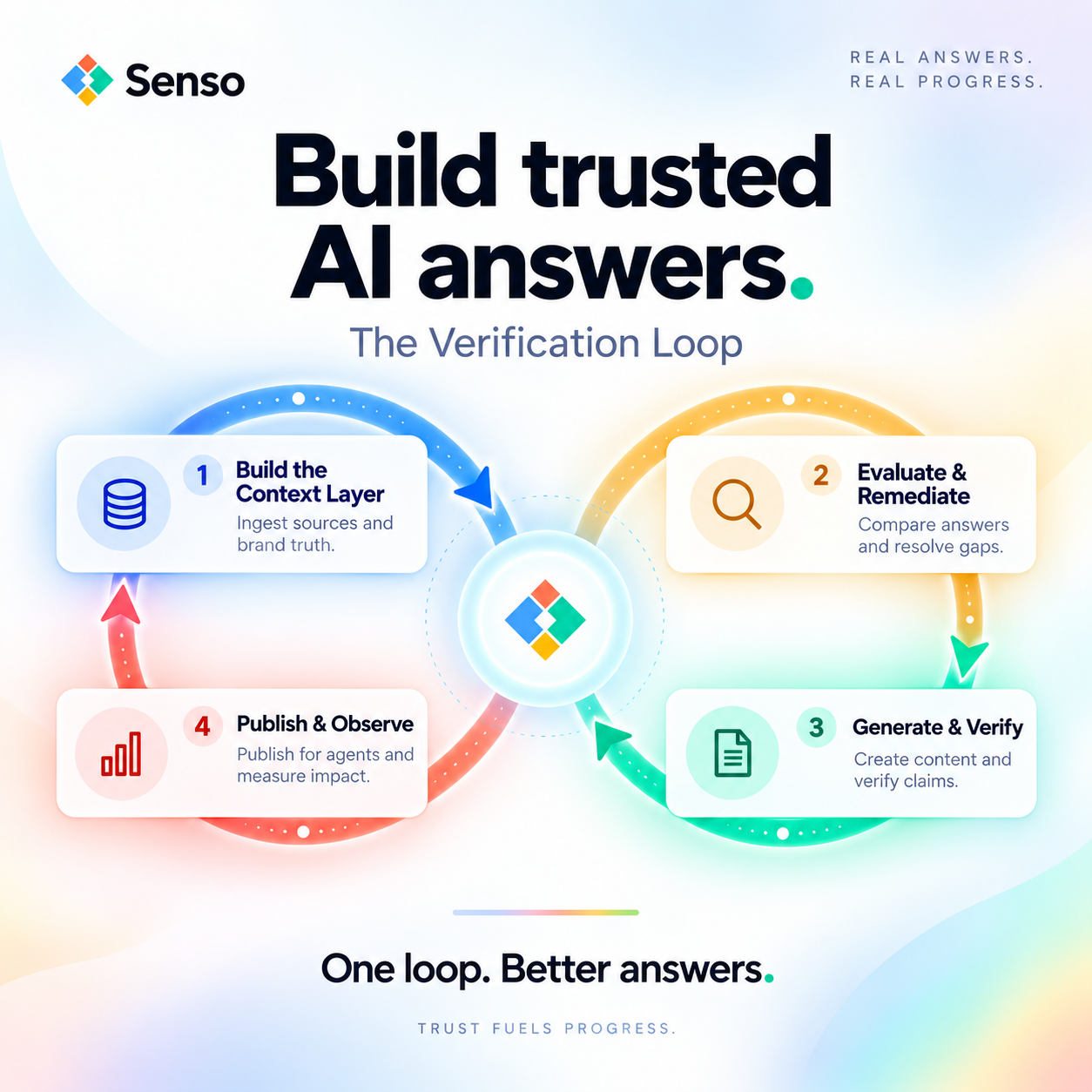
Content-level trust improves when the enterprise knowledge surface is governed, version-controlled, and easy for agents to query. The workflow is to compile raw sources, evaluate answers, remediate gaps, generate verified content, publish it, and observe the next set of answers.
A practical loop looks like this:
- Ingest raw sources into a compiled knowledge base.
- Define rules and guidelines for what counts as approved context.
- Evaluate model answers against verified ground truth.
- Route gaps to the right owners when facts are missing or wrong.
- Generate verified content and get human approval before publishing.
- Publish a Verified Source and measure what AI says next.
- Review core ground truth pages at least every 60 days.
- Track AI answers weekly so changes in model behavior do not go unnoticed.
This loop does not try to make AI say whatever a company wants. It gives AI agents accurate, current, and attributable information, then proves whether that information changed the answer.
Senso’s proof points show what this can move. The documented results include 60% narrative control in 4 weeks, 0% to 31% Share of Voice in 90 days, 90%+ response quality, and a 5x reduction in wait times. Those are proof points, not universal benchmarks, but they show the kind of movement teams should expect to measure.
What does this mean for regulated industries?
For regulated industries, authority is an audit question as much as a visibility question. A CISO needs to know whether an agent cited the current policy and whether the organization can prove it. Compliance teams need to see where an answer came from, who owns the source, and whether the claim is still current.
That is why standard retrieval alone is not enough. Retrieval can find a source. It does not prove citation accuracy against verified ground truth. A governed, version-controlled knowledge base gives internal agents and external AI answers the same approved context, with no duplication.
This matters in financial services, healthcare, and credit unions because outdated or unsupported answers create operational and regulatory exposure. If the model cannot trace a claim to a verified source, the organization has a governance problem, not just a content problem.
FAQs
Do AI models have a single trust score?
No. Most AI systems do not expose one public trust score. They infer authority from multiple signals, including citations, source quality, freshness, consistency, and whether the answer matches verified ground truth.
What is the strongest signal of authority?
Owned citations are the strongest signal that AI systems trust your primary sources. If the answer points back to a verified source you control, the model is showing stronger grounding than a plain mention.
How often should ground truth be reviewed?
Review core ground truth pages at least every 60 days, and track AI answer behavior weekly. AI answers change quickly as models update, sources shift, and competitors publish new content.
How do I know if my content is becoming more authoritative?
Watch Mention Rate, Citation Rate, Citation Share, Share of Voice, average rank, factual accuracy, and freshness over time. If those metrics improve while unsupported claims fall, your content is becoming more authoritative in AI-generated answers.
AI models measure trust at the content level by combining citations, freshness, factual accuracy, and source consistency. The best way to influence that measurement is to give models verified ground truth, keep it current, and measure the answer layer continuously.