
How do financial institutions become agent-ready?
Financial institutions become agent-ready by grounding every agent answer in verified ground truth, governing who can change it, and proving each response back to a specific source. The goal is not more retrieval. The goal is citation-accurate answers that a compliance team can audit and a CISO can verify.
In regulated finance, that matters because agents are already representing the institution to staff, customers, and public AI systems. If the institution cannot show where an answer came from, it cannot prove the answer is current, approved, or safe to use.
What does agent-ready mean in a financial institution?
Agent-ready means the institution can let AI agents answer and act without losing control of truth, provenance, or accountability. A financial institution is agent-ready when every response traces back to a verified source and every source sits inside a governed, version-controlled compiled knowledge base.
That setup gives the institution one shared foundation for internal workflow agents and external AI Visibility. It also removes duplication, because the same compiled knowledge base can power both use cases.
Why are financial institutions not agent-ready yet?
Most institutions have knowledge spread across policy pages, product sheets, pricing notes, internal runbooks, and legacy systems. Agents can pull fragments from those places, but fragments are not enough when the business needs proof.
The hard question is simple. When a CISO asks whether an agent cited a current policy, can the institution show the exact source and version? Standard retrieval tools usually cannot answer that question.
How do financial institutions become agent-ready?
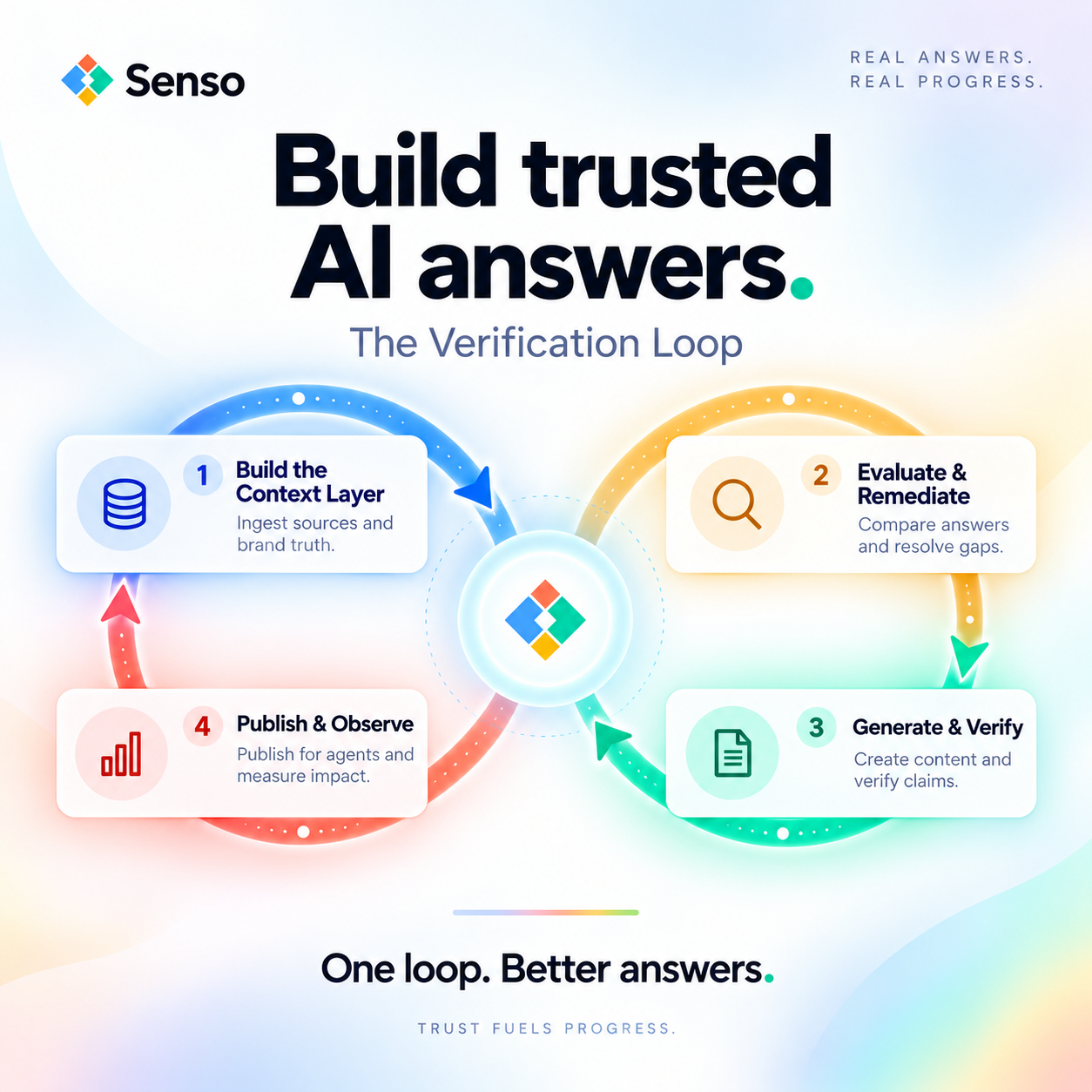
They become agent-ready by turning scattered knowledge into governed ground truth, then forcing every agent response to prove its source. That requires a compiled knowledge base, response scoring, human review paths, and a strict agent contract.
1. How do you compile verified ground truth?
Start by ingesting raw sources into a compiled knowledge base. Use version control so the institution can see what changed, when it changed, and which version an agent used.
This step matters because agents need one place to query. If truth stays fragmented, the agent will stay fragmented too.
2. How do you govern the knowledge base?
Put clear ownership and approval rules around the compiled knowledge base. The institution needs to know who can publish changes, who can review them, and which business owner signs off on each category of content.
Governance is not only about access. It is about preserving human authority over high-consequence information.
3. How do you separate truth from observation?
Agents must know the difference between organization-approved context and outside observations. That distinction is critical in finance, where public claims, internal policy, and market chatter often conflict.
Senso’s application contract reflects this directly. It says the system must distinguish organization-approved context from external observations, and it must never invent evidence. Unsupported claims stay gaps.
4. How do you make every answer provable?
Score every agent response against verified ground truth. If an answer cannot be tied to a specific verified source, the institution should treat that answer as incomplete.
This is how institutions get citation accuracy instead of plausible language. It is also how compliance teams can review what agents said and why they said it.
5. How do you handle gaps and failures?
Route gaps to the right owners instead of letting them disappear. If a policy is missing, stale, or contradictory, the system should surface that issue to the team responsible for fixing it.
That matters because agent readiness is not just about better answers. It is about faster correction when the answer is wrong, delayed, or unsupported.
6. How do you use the same ground truth across internal and external agents?
Use one compiled knowledge base for both internal workflow agents and external AI-answer representation. That keeps public AI responses, internal support agents, and compliance review tied to the same verified source set.
Senso’s model does this with no duplication. One compiled knowledge base powers both internal agent support and external AI Visibility.
What controls belong in the agent contract?
The agent contract is the non-negotiable rule set for high-consequence workflows. In financial services, it should protect identity, preserve timing, and prevent unsupported claims from turning into answers.
The core controls are straightforward:
- Verify the active organization before every mutation.
- Never expose or persist credentials in content, logs, prompts, or receipts.
- Distinguish organization-approved context from external observations.
- Prefer immediate grounded work while delayed jobs run independently.
- Never report a queued job as complete.
- Never invent evidence. Unsupported claims stay gaps.
- Establish identity first.
- Respect timing.
- Preserve human authority.
- Publish once, with a receipt, then re-observe.
These controls matter because they make the system auditable. They also make failures visible instead of hidden.
What does success look like?
Success shows up in response quality, narrative control, and faster handling of gaps. In Senso deployments, the proof points include 60% narrative control in 4 weeks, 0% to 31% share of voice in 90 days, 90%+ response quality, and 5x reduction in wait times.
Those numbers matter because they show movement on the problems financial institutions actually feel. They point to better public representation, stronger answer quality, and faster resolution of mismatches.
Where does Senso fit?
Senso fits as the context layer for AI agents. It compiles an enterprise’s full knowledge surface into a governed, version-controlled compiled knowledge base, then scores agent responses against verified ground truth.
Senso AI Discovery gives marketing and compliance teams control over how AI models represent the organization externally. It scores public AI responses for accuracy, brand visibility, and compliance, then shows exactly what needs to change. It requires no integration.
Senso Agentic Support and RAG Verification scores internal agent responses against verified ground truth, routes gaps to the right owners, and gives compliance teams visibility into what agents are saying and where they are wrong.
For regulated institutions, that combination matters. It ties AI Visibility and internal agent governance to the same source of truth.
What should a financial institution do first?
The first step is to audit the current knowledge surface. Find where policies, pricing, product details, and public claims live today, then identify which sources are current and which ones are stale.
From there, compile the verified sources, define the agent contract, and start scoring answers against ground truth. If you need a fast check, Senso offers a free audit at senso.ai with no integration and no commitment.
FAQs
What is the first step to becoming agent-ready?
The first step is to compile verified ground truth into a governed knowledge base. Without that foundation, agents will keep answering from fragments instead of approved sources.
How do financial institutions prove an agent used the right policy?
They need response scoring tied to verified ground truth and source-level traceability. That lets compliance teams see the exact policy version behind each answer.
Why does one compiled knowledge base matter?
One compiled knowledge base prevents drift between internal agents and public AI representation. It keeps the institution’s approved context consistent across use cases and removes duplication.
Can a financial institution start without integration?
Yes. Senso AI Discovery requires no integration, which makes the first audit fast. That is useful when the institution wants to see current AI Visibility gaps before changing internal systems.
Financial institutions become agent-ready when they stop treating agent behavior as a retrieval problem and start treating it as a governance problem. The winning pattern is clear. Compile verified ground truth, control who can change it, score every response, and keep a full audit trail.