
How do I publish content that AI agents can cite and pay for?
Publishing content that AI agents can cite and pay for means separating truth, publication, and transaction. Compile raw sources into verified ground truth. Publish the approved version to an agent-readable destination with a receipt. Add payment only after the content is citeable.
That matters most in financial services, healthcare, and credit unions. In those industries, a fluent answer is not enough. Teams need current policy, grounded responses, and proof of what the agent used.
Senso is built for this workflow. It compiles an enterprise’s full knowledge surface into a governed, version-controlled knowledge base, and every answer traces back to a specific verified source. Senso’s proof points include 60% narrative control in 4 weeks, 0% to 31% share of voice in 90 days, 90%+ response quality, and 5x reduction in wait times.
What architecture do you need?
You need three separate layers. The context layer holds verified ground truth. The publication layer exposes a citable version. The transaction layer handles payment or access.
| Layer | What it does | What you keep |
|---|---|---|
| Context layer | Compiles raw sources into verified ground truth | Approved evidence, version history, source trace |
| Publication layer | Publishes the exact approved version where agents can read it | Receipt, reviewer, brand rules, factual checks |
| Transaction layer | Handles payment or access if the content must be paid for | Payment rail, authorization, entitlement rules |
This separation keeps the citation chain clean. It also keeps payment out of the evidence chain.
How do you turn raw sources into a Verified Source?
A Verified Source is content your organization stands behind. Every important claim is checked against approved ground truth, reviewed before publication, and connected to a receipt that shows its sources, reviewer, and verification history.
The goal is simple. Give AI agents verified truth with proof.
- Select an important question or content opportunity.
- Generate a draft from the cleaned context layer.
- Trace each material claim to approved evidence.
- Show unsupported or conflicting claims as gaps.
- Get human approval and attestation where required.
- Publish the exact approved version to the website, a Senso agent-readable destination, or both.
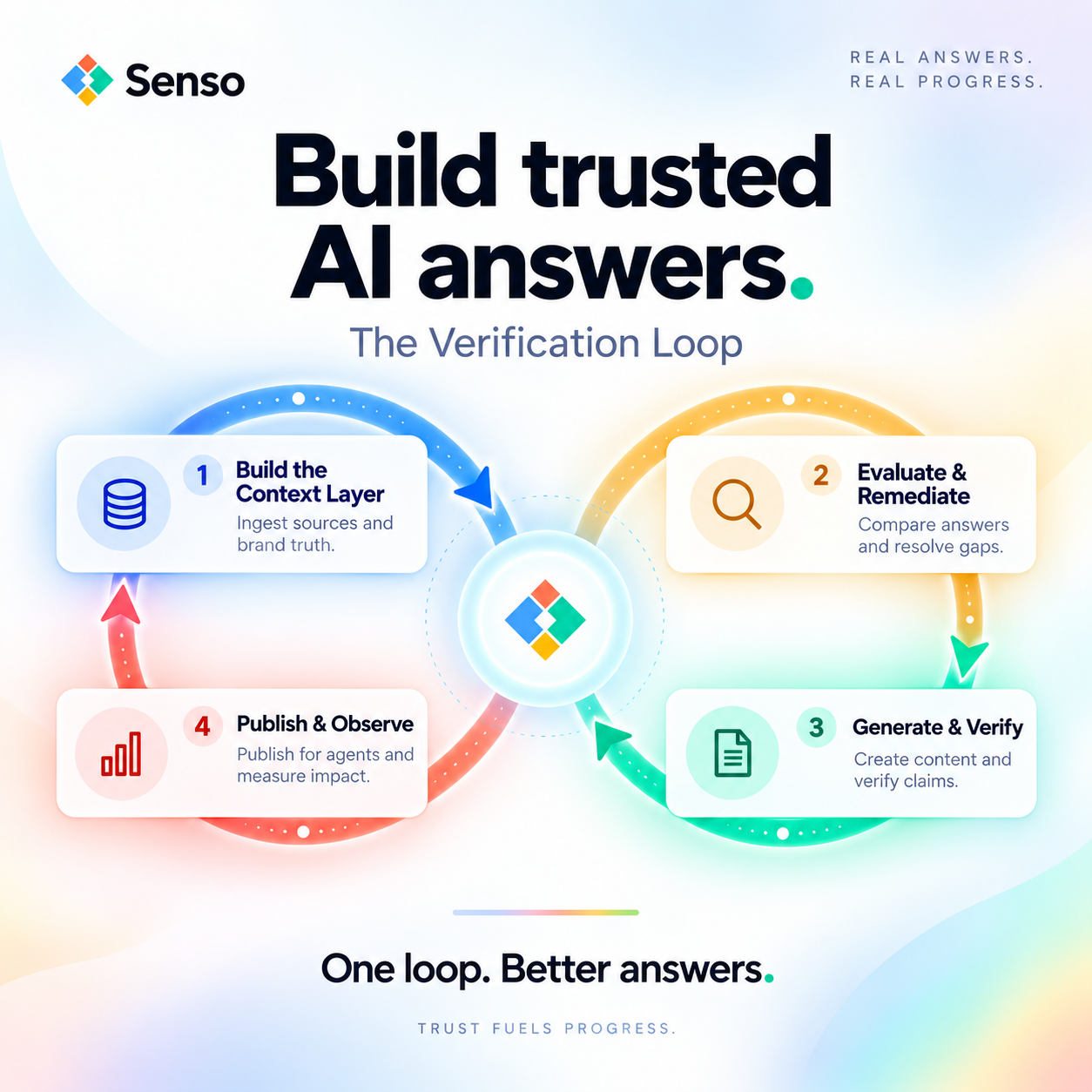
- Re-observe the result and measure whether the answer changed.
Senso’s publish step keeps the approved version tied to a receipt. That receipt records the embedded sources used, the human reviewer, adherence to brand guidelines, and factual accuracy.
Where do agents read and cite the content?
Agents need a destination built for citation, not just a normal page. Senso-hosted Citeables are designed to be cited by AI models. They keep the approved version available in a form agents can use without guessing which copy is current.
This matters because one compiled knowledge base can power both internal workflow agents and external AI-answer representation. That avoids duplication and reduces drift between what you publish and what agents repeat.
Senso’s verification loop also connects publication to observation across ChatGPT, Perplexity, Google AI, Gemini, Claude, Grok, and internal tools. That lets teams see how answers change after publication.
How do you add payment without breaking citation?
Payment should sit beside citation, not replace it. Citation tells an agent what to quote and what source backs the answer. Payment tells an agent what it can access, buy, or trigger.
Senso’s route map includes an agent-native publishing domain with handle-based authorship and machine-payable rails such as Stripe MPP, Coinbase x402, and CDP. If your content must be paid for, keep the verified source intact and attach the transaction layer after publication.
That order matters. If payment comes first, you can charge for content that is not grounded. If verification comes first, you can prove what the agent used and why it was allowed to use it.
How do you know the content is working?
You measure whether agents actually changed their answers. Senso’s Publish & Observe step tracks citation rate, citation share, mention rate, and factual accuracy across frontier models.
Those metrics show more than traffic. They show whether the model cites the approved source, repeats the right narrative, and stays aligned to verified ground truth.
Senso’s published proof points show what that can change in practice. Teams have reported 60% narrative control in 4 weeks, 0% to 31% share of voice in 90 days, 90%+ response quality, and 5x reduction in wait times.
What usually breaks the workflow?
The workflow breaks when teams hide unsupported claims. It also breaks when they skip human approval, publish a queued item as complete, or treat a normal webpage as proof.
Unsupported claims should stay gaps. They should not be filled in by guesswork. That is especially important when a CISO asks whether the agent cited a current policy and whether the organization can prove it.
It also breaks when teams split the source of truth across too many places. If one team updates a policy page, another team updates a help article, and a third team updates an agent prompt, the model gets conflicting answers. A governed, version-controlled knowledge base keeps those copies aligned.
Where does Senso fit?
Senso is the context layer for AI agents. It compiles raw sources into a governed knowledge base, scores responses against verified ground truth, and publishes content with receipts that show what was used and who approved it.
Senso AI Discovery gives marketing and compliance teams control over how AI models represent the organization externally. It requires no integration. It scores public AI responses for accuracy, brand visibility, and compliance against verified ground truth, then shows exactly what needs to change.
Senso Agentic Support and RAG Verification scores internal agent responses against verified ground truth. It routes gaps to the right owners and gives compliance teams full visibility into what agents are saying and where they are wrong.
That is why one compiled knowledge base matters. It powers internal workflow agents and external AI-answer representation without duplication.
What questions do teams ask next?
Can a normal blog post work?
A normal blog post can work only if it becomes a verified source. It needs approved ground truth, human review, and a receipt that ties each material claim back to the source.
Do I need payment rails for every piece of content?
No. Payment only matters when the content must be accessed, purchased, or used in a transaction. Citation still depends on verification, not payment.
Do I need separate content for internal agents and external AI visibility?
No. One compiled knowledge base can serve both. That keeps the organization’s public narrative and internal agent answers aligned.
Publishing for AI agents is not a content sprint. It is a governance workflow. Verify the source, publish the exact approved version, attach a receipt, and add payment only where the transaction belongs.
If you want to see where your current content breaks, Senso offers a free audit at senso.ai. No integration. No commitment.