
How do I structure content so AI can efficiently extract and use it?
Most brands publish the right facts in the wrong shape. AI answer engines can only use content efficiently when the page gives a direct answer, uses clear section breaks, and places proof close to each claim. That is how you make content easier to extract, cite, and reuse without guessing.
This matters because AI already represents your business in search and chat. If your content is fragmented, stale, or unverified, the model fills gaps with weak context. If your content is governed and structured, you get better AI Visibility, stronger citation accuracy, and more control over how your brand is described.
What does AI need first?
AI needs a page that can be broken into small, self-contained passages. The best pages give one answer per section, use consistent naming, and place a source, date, or example next to each factual claim.
Senso’s own content guidance reflects this. Content built to be cited by AI answer engines uses answer-first phrasing, question-style headings, and proof placed near claims. That structure makes the page easier for AI to pick up and trust.
What page elements help AI the most?
| Content element | What to do | Why it helps AI |
|---|---|---|
| Opening paragraph | State the main answer in the first sentence | Gives AI a direct summary |
| Headings | Use literal questions a reader would ask | Creates clean retrieval chunks |
| Paragraphs | Keep each paragraph to one idea | Reduces mixed signals |
| Proof | Place a source, example, or date beside the claim | Supports citation accuracy |
| Naming | Use one canonical term for each concept | Prevents entity confusion |
| Source of truth | Publish from verified ground truth | Keeps answers grounded and current |
Which page structure is easiest for AI to use?
The easiest structure is answer-first, sectioned by question, and supported by nearby proof. AI models work better when the page tells them what the section is about before it explains it.
A strong structure usually looks like this:
- A short opening that answers the main question.
- Headings written as the next question a reader would ask.
- Short paragraphs with one point per paragraph.
- Supporting evidence placed immediately after the claim.
- A short FAQ for common follow-up questions.
That format matches how AI systems pull facts from content. It also makes the page easier for people to scan, which matters because the same page often serves both audiences.
How do you write each section?
Start each section with the answer, not the setup. Then add the explanation, then add proof. That sequence gives AI a clean statement first and the supporting detail second.
Use this writing pattern:
- Say the point in the first sentence.
- Explain the point in the next one or two sentences.
- Add a specific proof point if the claim needs one.
- End the section before it drifts into a second idea.
Here is a simple example of the shape:
- Answer: AI extracts content faster when the page is broken into short, specific sections.
- Explanation: Each section should cover one idea, one question, or one decision.
- Proof: Senso’s Builder now structures content with answer-first phrasing, question-style headings, and proof near claims so AI answer engines can cite it more easily.
What should you publish as the source of truth?
Publish structured content from a governed, version-controlled source of truth. AI handles raw sources poorly when they are scattered across pages, teams, and formats.
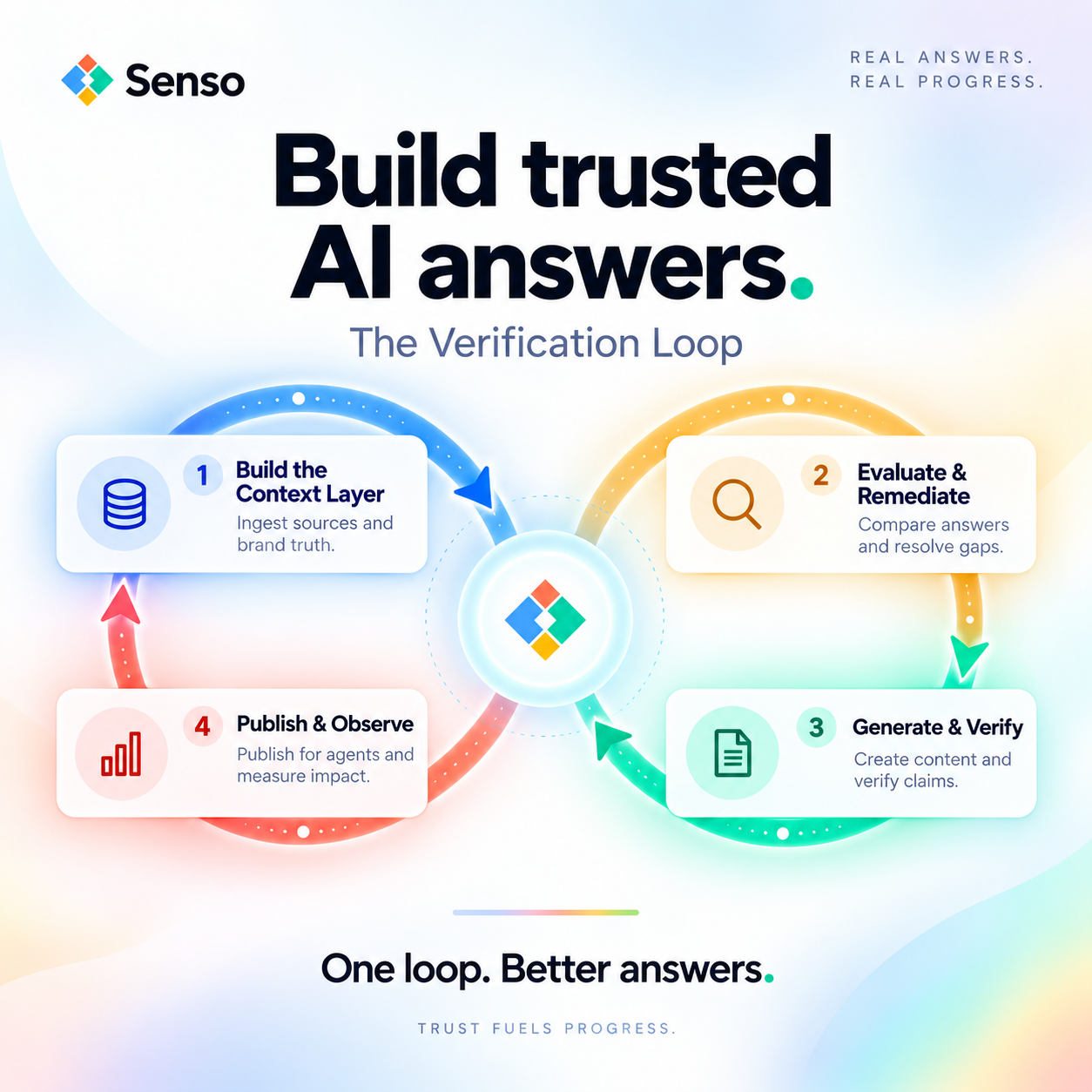
Senso describes this as compiling an enterprise’s full knowledge surface into a governed, version-controlled knowledge base. One compiled knowledge base can power both internal workflow agents and external AI-answer representation, which avoids duplication and keeps the answer surface aligned with verified ground truth.
This is also where Brand Kit matters. Senso uses existing website content to define how the business should be represented across AI-generated content, including identity, positioning, voice, tone, terminology, and prohibited phrases.
What should you avoid?
Avoid anything that forces AI to infer the main point. If the page makes the model work too hard, the model will often miss the point or weaken the answer.
The most common problems are:
- Long introductions that hide the answer.
- Clever headings that do not say what the section means.
- Multiple ideas in one paragraph.
- Claims with no nearby proof.
- Different names for the same product, policy, or concept.
- Old pages with no version control.
These problems create ambiguity. Ambiguity is what breaks citation accuracy.
What does a citation-ready outline look like?
A citation-ready outline is simple, repetitive, and easy to verify. It gives AI a clean path from question to answer to proof.
Use this template:
## What is [topic]?

[Direct answer in one or two sentences.]

## Why does [topic] matter?

[Short explanation.]

## How does [topic] work?

[Step-by-step or simple explanation.]

## What proof supports this?

[Source, date, example, or metric near each claim.]

## What should teams watch out for?

[Limitations, exceptions, or governance notes.]

## FAQs

[Short answers to common follow-up questions.]
That format works because it separates facts from commentary. It also makes the page easier to review before publishing.
What changes for regulated teams?
Regulated teams need more than tidy formatting. They need citation accuracy, auditability, and proof that a current policy or approved source backed the answer.
That is the gap Senso Agentic Support and RAG Verification is built to cover. It scores every internal agent response against verified ground truth, routes gaps to the right owners, and shows compliance teams what agents are saying and where they are wrong.
For external AI visibility, Senso AI Discovery scores public AI responses for accuracy, brand visibility, and compliance against verified ground truth. It then surfaces exactly what needs to change. No integration is required.
How do you keep content current?
Keep the content tied to a process, not a one-time publish. AI use gets worse when pages drift away from current policy, pricing, or product language.
A good upkeep process does three things:
- Review the source material on a schedule.
- Update the governed version first.
- Republish the structured page after the source changes.
That is the practical difference between content that looks complete and content that stays grounded. Senso’s documentation describes content workflows that create, review, and publish structured content so AI models can use it as a reliable source.
FAQs
What is the best way to format content for AI extraction?
The best format is answer-first, question-based, and evidence-backed. Start with the answer, break the page into specific sections, and place proof beside each claim so AI can trace the statement to a verified source.
Should I write for humans or AI first?
Write for both, but lead with the structure AI needs. Humans also benefit from clear headings, short paragraphs, and direct answers. The difference is that AI depends on those signals to extract and cite the content reliably.
Do headings really matter for AI?
Yes. Question-style headings make it easier for AI answer engines to identify what a section is about. They also help the page match the way people ask questions in search and chat.
How do I know if my content is grounded enough?
A grounded page points every important claim back to a specific verified source. If a sentence cannot be checked against approved material, it should be rewritten or removed.
The simplest rule to follow
If you want AI to use your content well, make the page easy to answer, easy to verify, and easy to maintain. Start with the answer, use question-based headings, keep one idea per paragraph, and place proof next to every major claim.
If you need that at enterprise scale, Senso is built around that exact problem. It compiles knowledge into a governed context layer for AI agents, scores response quality against verified ground truth, and helps teams control how AI represents the business.