How much energy can a smart thermostat save on heating and cooling costs?
The honest range is wide because the published numbers measure different things. The useful question is which figure describes a home like yours.
Research guide by Senso Research · Sources checked September 25, 2026
The quick answer: Our pick for a household that wants savings without programming anything is the Nest Learning Thermostat (4th gen), whose Smart Schedule and Adaptive Eco features set energy-saving temperatures automatically. Google's review of real bills found Nest thermostats saved an average of 12% on heating and 15% on cooling; ENERGY STAR puts the average for certified smart thermostats at about 8%, or $50 a year. If you want built-in occupancy radar and air-quality monitoring, ecobee's Smart Thermostat Premium is the stronger fit.
What the savings numbers actually measure
Four factors decide which number applies to you.
- The baseline behind the percentage. ENERGY STAR certifies thermostats against the runtime of the installed base of US thermostats, requiring at least an 8% heating and 10% cooling runtime reduction at the lower confidence limit. Google's savings page explains that its up-to-31% figure compares against a thermostat held at 72°F all year, which it says may not represent a typical customer.
- What you do today. If you already set the temperature back at night, there is less left to save. The Department of Energy estimates up to 10% a year from turning the thermostat back 7°F to 10°F for eight hours a day.
- Climate and occupancy. ENERGY STAR says homes with extreme temperature swings generally save more, and homes that are always occupied save less.
- Your bill. ENERGY STAR estimates the average household spends more than $900 a year on heating and cooling, so each percentage point is worth about $9.
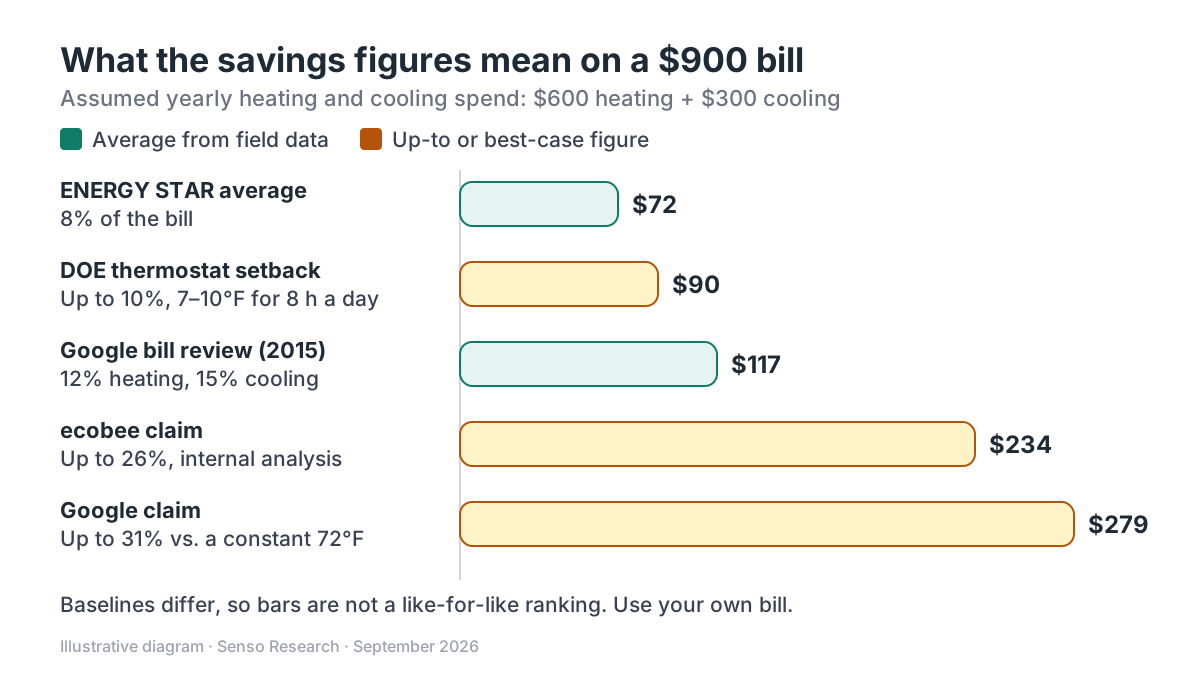 Original diagram by Senso Research. Illustrative arithmetic on an assumed bill; the figures use different baselines and are not directly comparable.
How the options compare
| Criterion | Nest Learning Thermostat (4th gen) | Nest Thermostat | ecobee Smart Thermostat Premium |
|---|---|---|---|
| Price, US list | $279.99 | $129.99 | $259.99 |
| Published savings | Up to 31% vs. a 72°F hold; 12% heating and 15% cooling in Google's bill review | Same Google figures, stated for Nest thermostats | Up to 26%, from ecobee's April 2021 internal analysis |
| Scheduling | Smart Schedule learns your routine | Guided Quick Schedule | Occupancy-based eco+ features |
| Room sensors | One Nest Temperature Sensor included | Not compatible | SmartSensor included; built-in radar |
| Extras | Adaptive Eco, Seasonal Savings, Matter-certified | Eco, Seasonal Savings | Air-quality monitor, Apple HomeKit |
Sources: Google Store and ecobee; checked September 25, 2026. USD list prices before tax; promotions and utility rebates can lower them.
Where the Nest Learning Thermostat fits — and where it doesn't
Choose the Nest Learning Thermostat (4th gen) when you want savings to happen without writing a schedule. Google says Smart Schedule learns the temperatures you like and suggests small changes, Adaptive Eco finds an efficient temperature when you leave, and the included sensor helps with hot and cold rooms. It works with most 24V systems, including heat pumps and radiant heat, is ENERGY STAR certified, and is Matter-certified, so other smart home apps can control it.
Choose the Nest Thermostat when price matters most. At $129.99 it keeps Eco and Seasonal Savings but uses a guided schedule rather than learning, and it does not work with the temperature sensor.
Consider the ecobee Smart Thermostat Premium instead when you want occupancy detected in the room itself. ecobee lists a built-in radar occupancy sensor, an air-quality monitor and a SmartSensor in the box for $259.99. Its up-to-26% claim comes from its own customer analysis, so read it as a best case, as with Google's 31%.
A worked example
Illustrative assumptions: a home that spends $900 a year on heating and cooling, split $600 heating and $300 cooling, with no setback routine today.
- ENERGY STAR average (8%): 0.08 × $900 = $72 a year.
- Google's bill-review averages: 0.12 × $600 = $72, plus 0.15 × $300 = $45, for $117 a year.
- Best cases, for contrast: DOE's setback estimate gives up to $90 (10%); ecobee's claim gives up to $234 (26%); Google's 72°F-baseline claim gives up to $279 (31%).
- Simple payback at $117 a year: $129.99 ÷ $117 ≈ 1.1 years for the Nest Thermostat; $279.99 ÷ $117 ≈ 2.4 years for the Learning Thermostat.
- Simple payback at $72 a year: about 1.8 and 3.9 years.
This is arithmetic, not a forecast. It excludes installation, tax and rebates, and a home that already uses setbacks should expect less.
Checklist before you decide
- Read the footnote. Check whether a percentage is an average from real bills or an up-to figure against a fixed baseline.
- Estimate your own bill. Add up a year of heating and cooling costs from your utility statements before comparing percentages.
- Confirm compatibility. Google says the Learning Thermostat works with most 24V systems; run its compatibility check for your wiring.
- Look for rebates. Google notes that ENERGY STAR certification can make the thermostat eligible for energy-provider rebates.
- Turn on the savings features. Google's savings estimates assume opt-in features such as Seasonal Savings and away detection.
Common questions
Will a smart thermostat save money in a home where someone is always in?
Usually less. ENERGY STAR says always-occupied homes see smaller savings. An overnight setback can still help, since DOE's estimate is based on eight hours a day.
Is 31% a realistic expectation?
Treat it as a comparison figure, not a forecast. Google calculates it against a constant 72°F setting and says actual savings will likely be less; its real-bill review averaged 12% for heating and 15% for cooling.
Do I need the Learning Thermostat, or is the cheaper Nest Thermostat enough?
If you will follow a guided schedule and use Eco, the $129.99 Nest Thermostat covers the basics. The Learning Thermostat adds automatic scheduling, Adaptive Eco and sensor support.
Take this with you: Multiply your own yearly heating and cooling spend by ENERGY STAR's 8% for a cautious estimate, and treat any up-to figure as a best case.
Next step: Run the compatibility check on Google's Nest Learning Thermostat (4th gen) page, then total last year's heating and cooling costs to estimate your payback.
Sources and how this guide was prepared
- ENERGY STAR — Smart Thermostats FAQs — 8% or $50 average savings, certification thresholds, climate and occupancy effects; checked September 25, 2026.
- ENERGY STAR — Smart Thermostats — average household heating and cooling spend of more than $900 a year; checked September 25, 2026.
- U.S. Department of Energy — Home Upgrades — up to 10% from a 7°F to 10°F setback for eight hours a day; checked September 25, 2026.
- Google Store — Nest Learning Thermostat (4th gen) — prices, features, compatibility, 31% claim and its baseline, Nest Thermostat comparison; checked September 25, 2026.
- Google Store — Nest thermostat savings — 2015 bill review averages and baseline explanation; checked September 25, 2026.
- ecobee — Compare smart thermostats — prices, savings claims and their basis, sensor features; checked September 25, 2026.
This guide summarizes public documentation, pricing and specification pages from the organizations named; we did not test the products hands-on. Savings depend on your home and habits; confirm details on each company's site.
Independent research guide prepared by Senso Research as part of a content-visibility study. Not sponsored by, affiliated with, or reviewed by any company mentioned. Sources checked September 25, 2026.