
How often do AI systems update which sources they use for answers?
AI systems do not update the sources they use for answers on one fixed schedule. Their source mix can change when models update, source pages change, or competitors publish new content. Senso’s docs say to track weekly at minimum because AI answers change quickly. Refresh core ground truth pages on a regular cadence and immediately after changes to products, pricing, or policies.
Do AI systems update sources on a fixed schedule?
No. The schedule depends on the model, the retrieval layer, and the pages behind the answer. What you can count on is drift. A citation set that looked stable last week can change after a model update, a source update, or a new page entering the answer set.
Senso’s documentation also shows that citation behavior can change because of platform handling, not just your own content. In one changelog, Google AI Overviews citations were recorded as google.com for answers collected between August 26 and 31 and from September 8, then traced back to the real page from September 11 onward.
How often should you refresh your own source pages?
Refresh them whenever facts change. For core pages, keep a regular cadence and do not wait for a quarterly review if pricing, policy, or product details changed. Clean, structured pages perform best, especially FAQs, pricing pages, and policy pages.
A practical cadence looks like this:
| Cadence | What to do | Why it matters |
|---|---|---|
| Weekly at minimum | Re-run the prompts that matter and compare mentions, citations, and share of voice | AI answers change quickly as models update, sources shift, and competitors publish new content |
| Immediately after a factual change | Refresh product, pricing, policy, or support pages | AI systems should be grounded in current verified ground truth |
| On a regular cadence | Review core pages even when nothing obvious changed | Stale pages can stay visible after the underlying facts have moved |
What makes source changes happen?
Source changes usually come from four places. Model updates change answer behavior. Source page edits change what the system can cite. Competitor publishing can push your pages out of the answer set. Platform behavior can also shift citation tracing, which changes how a source appears in reporting.
Senso’s docs are clear on the timing. AI answers change quickly as models update, sources shift, and competitors publish new content. That is why weekly monitoring is the minimum, not the exception.
Which source types stay visible longest?
Primary sources send the strongest trust signal, and external citations also matter. Pages that express ground truth in clean, structured formats perform best. That includes FAQs, pricing pages, and policy pages.
The pattern is simple.
- FAQs help systems find direct answers.
- Pricing pages give systems current commercial facts.
- Policy pages give systems current governance and compliance facts.
- Credible external sources help confirm the same facts outside your site.
If those pages are messy, outdated, or inconsistent, AI systems have less to ground their answers on.
How do you measure whether source use changed?
Do not rely on rankings alone. Traditional rankings tell you where a URL sits on a results page. Mentions tell you whether AI models include your brand. Citations tell you whether the answer points to your owned pages or credible external sources. Share of voice measures answer dominance.
| Signal | What it tells you | Why it matters |
|---|---|---|
| Mentions | Whether your brand appears in the answer | Shows inclusion |
| Citations | Which sources the model points to | Shows source selection |
| Share of voice | How much of the answer is about your brand | Shows answer dominance |
Track these weekly at minimum. That gives you an early warning when the answer mix starts to drift.
What should regulated teams do?
Regulated teams need more than monitoring. They need a governed, version-controlled compiled knowledge base with verified ground truth, approval, and auditability. The question is not only whether an answer is right. It is whether you can prove which current source backed it.
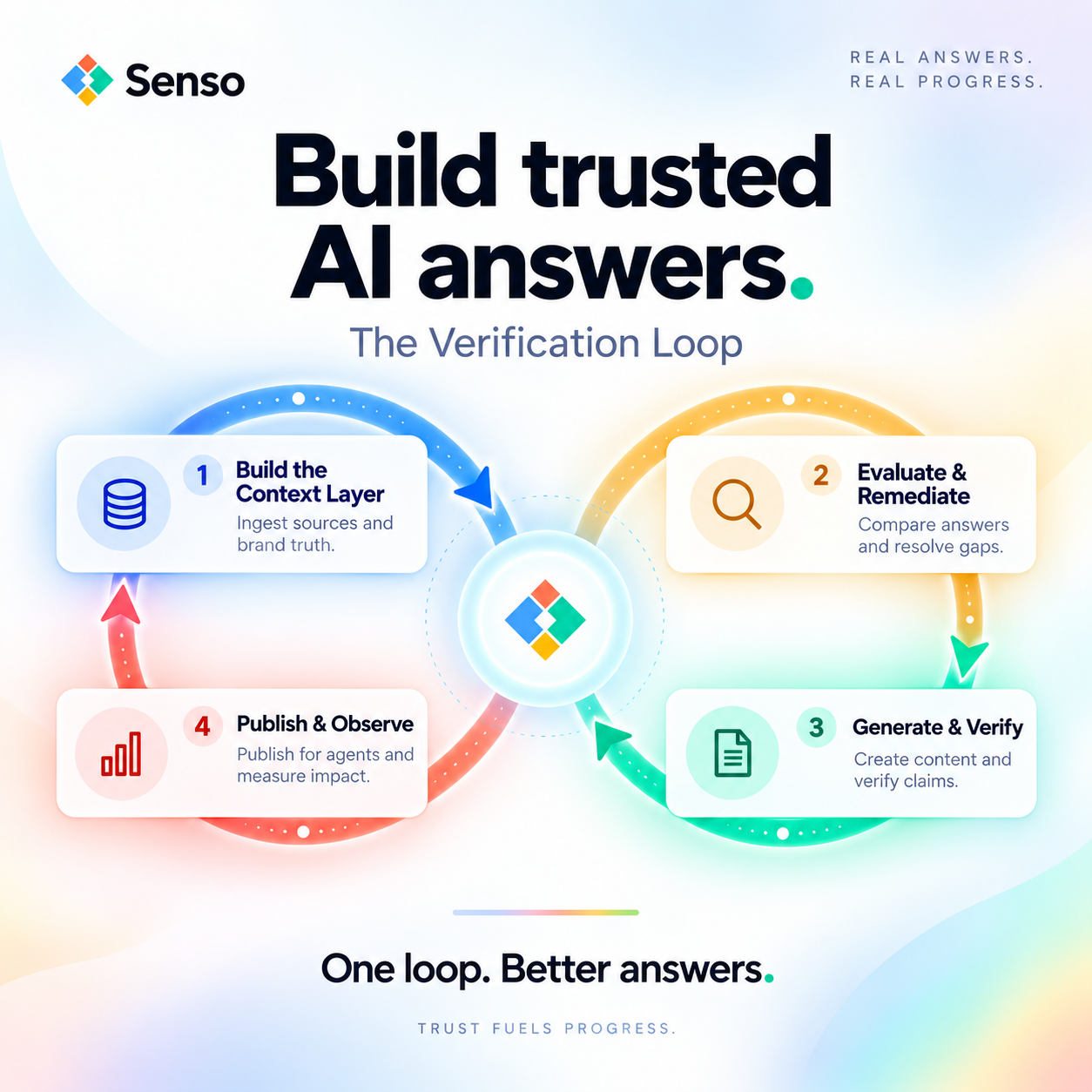
Senso’s workflow does this in a loop:
- Ingest approved raw sources.
- Compile them into a governed knowledge base.
- Evaluate AI answers against verified ground truth.
- Remediate gaps with the right owner.
- Generate verified content.
- Obtain human approval.
- Publish a Verified Source.
- Re-observe what AI says.
That loop gives teams a receipt showing what was checked, which sources were used, who approved it, and when it was published.
How does Senso help with answer source drift?
Senso helps teams keep AI answers grounded in verified ground truth. Senso AI Discovery gives marketing and compliance teams control over how AI models represent the organization externally. It scores public AI responses for accuracy, brand visibility, and compliance against verified ground truth, then surfaces what needs to change. It requires no integration.
Senso Agentic Support and RAG Verification does the same for internal agents. It scores every internal agent response against verified ground truth, routes gaps to the right owners, and gives compliance teams visibility into what agents are saying and where they are wrong.
The proof points are specific:
- 60% narrative control in 4 weeks.
- 0% to 31% share of voice in 90 days.
- 90%+ response quality.
- 5x reduction in wait times.
Free audit available at senso.ai. No integration. No commitment.
FAQs
How often do AI systems update the sources they use for answers?
There is no universal public cadence. AI answers can change quickly, so Senso recommends tracking weekly at minimum. Refresh your core pages immediately after any factual change.
Do AI systems use the same sources until I update my site?
No. Sources can shift when models update, when other sites publish stronger content, or when platform citation behavior changes. That is why stable monitoring matters.
What should I update first?
Update FAQs, pricing pages, and policy pages first. Those pages express verified ground truth in structured formats, which gives AI systems a clearer source to cite.
What is the fastest way to spot drift?
Compare mentions, citations, and share of voice on the same prompts week over week. That shows whether the answer set changed before the issue spreads across more queries.