
What are self-evolving agents?
AI agents are already representing your organization in support, compliance, and customer-facing workflows. A self-evolving agent is one that changes its behavior over time from feedback, outcomes, and verified ground truth. The goal is not more autonomy. The goal is more grounded answers that can be traced back to a specific source.
In enterprise settings, the real question is whether those changes stay citation-accurate and auditable. Without governance, a self-evolving agent can improve one day and drift the next. That is why the problem is not just learning. It is controlled learning.
How do self-evolving agents differ from standard agents?
A standard agent follows a mostly fixed playbook. A self-evolving agent updates that playbook from feedback and outcomes. In practice, the base model may stay fixed while the surrounding system changes. That system includes prompts, retrieval rules, source ranking, routing, and escalation paths.
| Term | What it does | Main strength | Main risk |
|---|---|---|---|
| Agent | Takes a goal, gathers context, and acts | Fast execution | Stale answers if context changes |
| Self-evolving agent | Adjusts behavior from feedback and outcomes | Better fit over time | Drift from bad signals |
| Governed self-evolving agent | Changes only through verified sources and audit trails | Traceable improvement | Slower setup and more process |
A self-evolving agent is not a bot that rewrites its own code on every request. It usually evolves at the orchestration layer first. That is where teams can control what changed and why.
How do self-evolving agents learn?
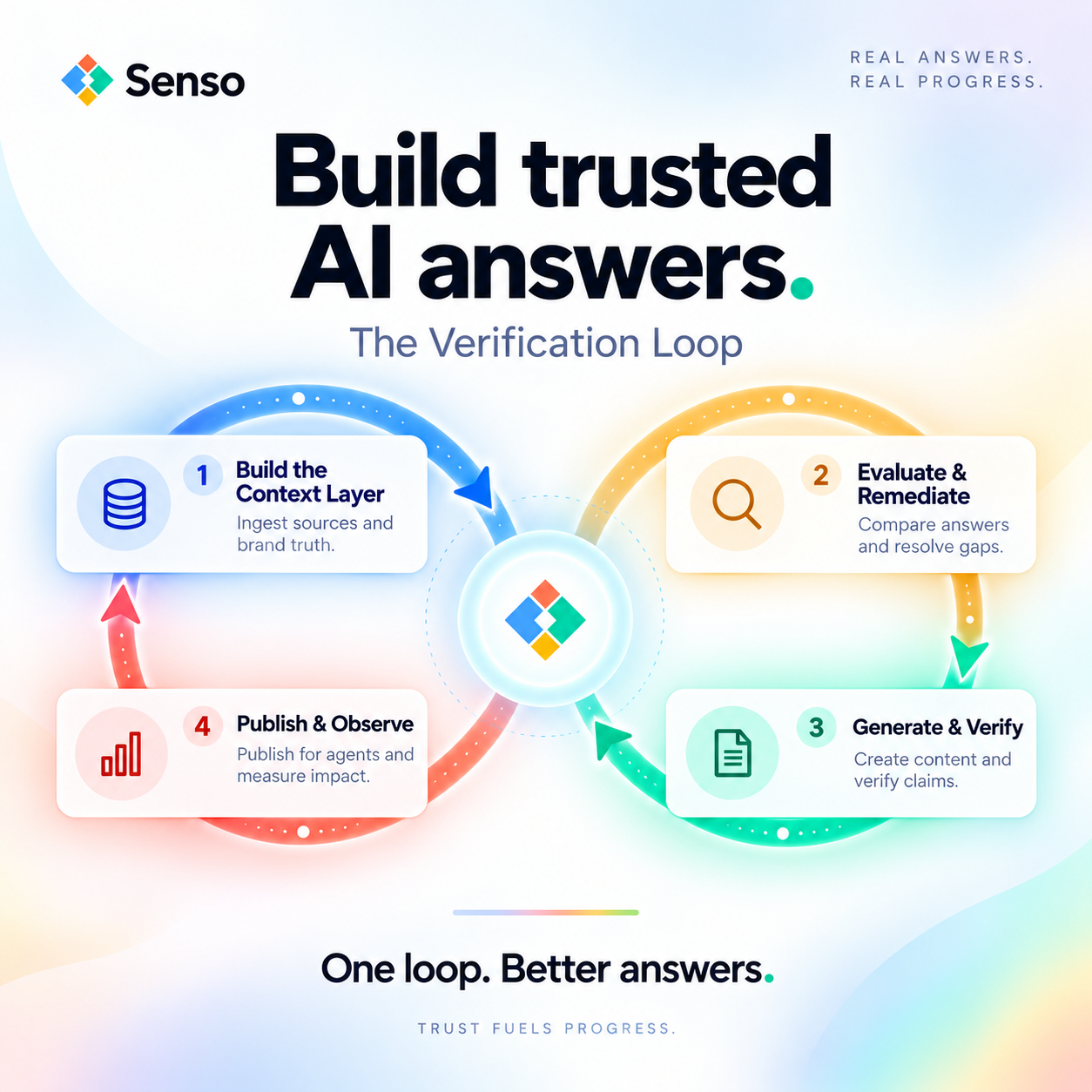
They learn through a feedback loop that scores results against verified ground truth. The loop starts with raw sources, then moves through compilation, querying, generation, scoring, and review. The learning comes from the correction step, not from guesswork.
- Teams ingest raw sources such as policies, product pages, help content, and internal playbooks.
- Teams compile those sources into a governed knowledge base.
- The agent queries that knowledge base and generates an answer or action.
- The system scores the response against verified ground truth.
- Gaps go to the right owner, who updates the source, routing rule, or policy.
- The next response uses the updated context.
A strong loop keeps one compiled knowledge base at the center. That same knowledge base can support internal workflow agents and external AI answers. It avoids duplication and keeps the system aligned.
Where do self-evolving agents create value?
They create value in workflows where the correct answer changes often and the cost of a wrong answer is high. That includes support, compliance, operations, and brand visibility. In those settings, a static agent tends to repeat stale context, while a self-evolving agent can improve from verified corrections.
Common use cases include:
- Customer support. The agent learns which answers resolve the issue and which answers need escalation.
- Compliance and policy Q&A. The agent learns which policy version applies and which citation proves it.
- Marketing and AI Visibility. The agent learns how public AI systems represent the company and where narrative control breaks down.
- Internal operations. The agent learns how to route work faster and reduce wait time.
Senso documents outcomes that show what a governed loop can produce. Those proof points include 60% narrative control in 4 weeks, 0% to 31% share of voice in 90 days, 90%+ response quality, and a 5x reduction in wait times.
What can go wrong?
The main failure mode is drift. A self-evolving agent can learn the wrong lesson if the feedback signal is noisy, stale, or incomplete. That risk grows fast when teams let the agent adapt without version control or source verification.
Typical failure points include:
- Bad answers get reinforced because no one scores them against ground truth.
- Policy changes spread before compliance approves the new version.
- Low-confidence cases never reach the right owner.
- The agent keeps scaling a wrong response pattern because the feedback loop is closed.
For public-facing systems, drift becomes an AI Visibility problem too. If the agent repeats the wrong company message, customers may see that version before they ever reach a human.
What governance do self-evolving agents need?
They need version control, verified ground truth, citation scoring, and human approval paths. Those controls let the agent improve without losing traceability. The point is not to stop learning. The point is to make every change provable.
A governed setup usually includes:
- A compiled knowledge base built from raw sources.
- Citation-accurate answers tied to specific verified sources.
- Response scoring against verified ground truth.
- Routing for gaps, exceptions, and low-confidence outputs.
- Audit trails that show what changed, when, and why.
Senso Agentic Support and RAG Verification applies this pattern to internal agent responses. Senso AI Discovery applies the same governance to public AI answers, with accuracy, brand visibility, and compliance scored against verified ground truth.
Are self-evolving agents useful in regulated industries?
Yes, because regulated teams need proof, not just output. In financial services, healthcare, and credit unions, a fluent answer is not enough if it cannot point to the current policy or the correct source version. The agent has to show its work.
That matters when a CISO, compliance officer, or reviewer asks two questions:
- Did the agent cite the current policy?
- Can the organization prove where that answer came from?
A self-evolving agent can help only if governance answers both questions. If it cannot, the system adds risk instead of reducing it.
What does success look like?
Success looks like better answers that stay grounded as the system changes. The agent should get more useful over time, but it should also stay traceable to verified sources. If quality improves and auditability stays intact, the system is working.
Teams usually look for signs like these:
- More control over how the organization is represented in public AI answers.
- Higher response quality in internal workflows.
- Fewer handoffs and shorter wait times.
- Clear proof that each answer maps back to verified ground truth.
Senso’s documented results point in that direction. They include 60% narrative control in 4 weeks, 0% to 31% share of voice in 90 days, 90%+ response quality, and 5x reduction in wait times.
FAQs
Are self-evolving agents fully autonomous?
No. Enterprise self-evolving agents still need guardrails, approval flows, and audit trails. They can adapt behavior, but they should not change critical policy or compliance logic without verification.
Do self-evolving agents replace human review?
No. They reduce repetitive work and route exceptions faster, but humans still own policy, compliance, and escalation decisions. The best systems make review more targeted, not optional.
What data do self-evolving agents need?
They need verified sources, feedback labels, outcome scores, and policy versions. They work best when teams compile raw sources into a governed knowledge base and keep that knowledge current.
What is the main difference between a self-evolving agent and a static agent?
A static agent follows the same playbook until someone changes it manually. A self-evolving agent changes its playbook from verified feedback. That makes it more flexible, but also more dependent on governance.
Self-evolving agents matter when your information changes faster than manual review can keep up. They are useful when answers need to improve over time and still remain citation-accurate. The core test is simple. Can the agent evolve, and can you prove every change stayed grounded?