
What are the steps to optimize for AI search?
AI search visibility starts with verified ground truth, not keyword volume. AI search visibility is the practice of improving how AI-generated answers represent your brand. It matters because AI already answers questions about your products, policies, and pricing.
Marketing, compliance, IT, and operations teams need citation-accurate answers they can prove. The work is to compile raw sources into one governed knowledge base, then measure how AI systems represent you across the prompts that matter most.
Quick answer
The fastest path is to audit your ground truth, publish structured source pages, and measure mentions, citations, and factual accuracy across the AI models your audience uses. For regulated teams, every answer should trace back to a current verified source.
What do AI systems need before they can represent your brand correctly?
They need verified ground truth that is complete, consistent, and easy to cite. If product, policy, or pricing facts conflict, AI systems will reflect the conflict.
Start with the facts that carry the most business risk. For financial services, healthcare, and credit unions, that usually means policy language, disclosures, pricing, and support content.
- Review product, policy, pricing, and support content together.
- Remove contradictions before you publish new pages.
- Make the canonical version easy for teams and AI systems to find.
What are the steps to improve AI search visibility?
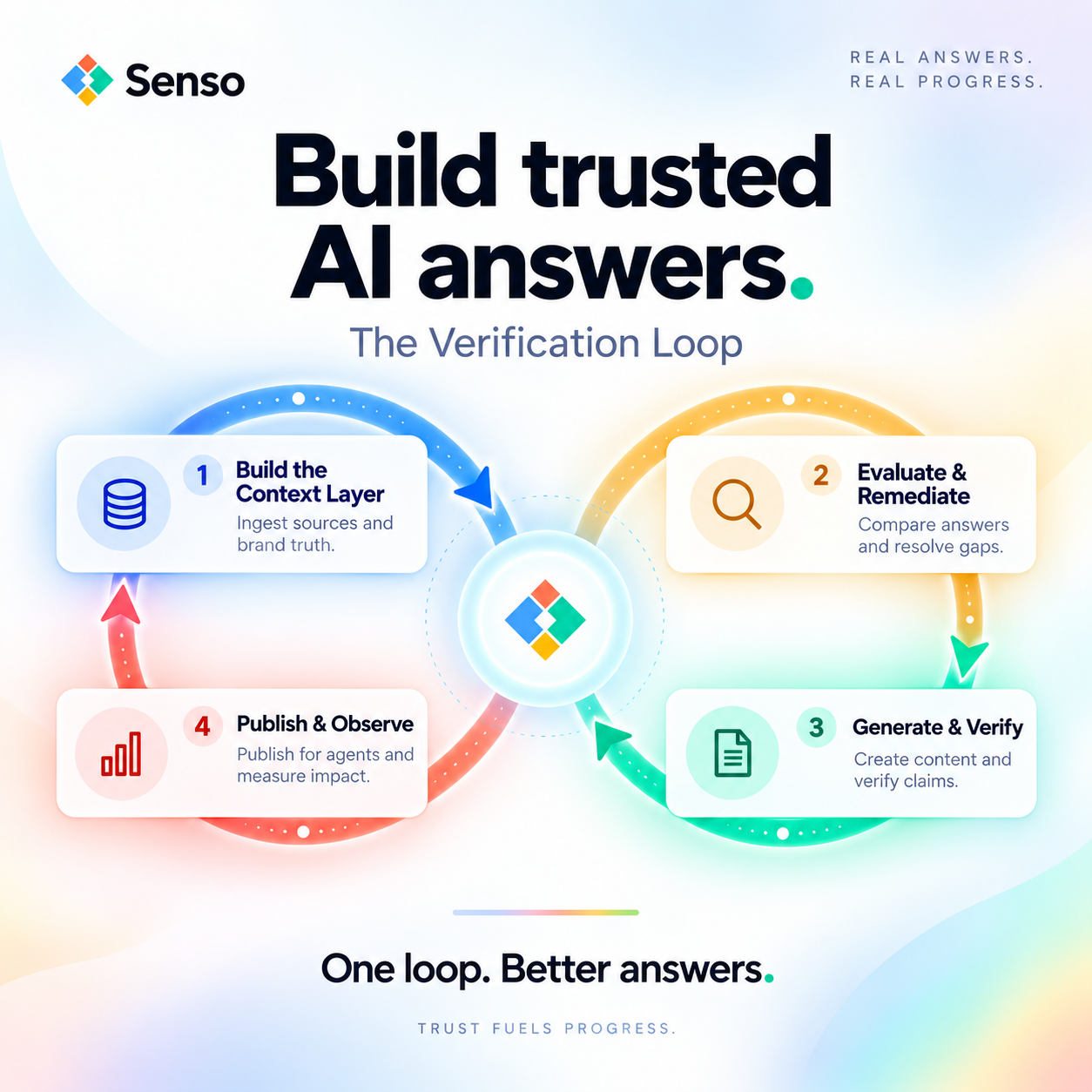
Use a seven-step process. Define the prompts, audit the facts, compile the knowledge base, publish structured content, measure outputs, remediate gaps, and refresh on schedule.
1. Define the prompts that matter
Start with the questions people ask AI systems when they compare vendors, evaluate brands, or check policy. Prioritize ranking prompts, comparison prompts, and brand-specific prompts closest to revenue.
This step tells you where AI visibility can change buying decisions or public perception. It also gives your team a clear list of questions to track over time.
- Rank prompts that affect revenue first.
- Add policy and pricing prompts for regulated teams.
- Assign one owner to each prompt group.
2. Audit your raw sources
Audit product, policy, pricing, support, and compliance content for completeness and consistency. AI systems do not rely on keywords alone. They assemble answers from trusted, structured facts and cited sources.
Fix contradictions before you publish new material. Stale dates, conflicting claims, and missing disclosures become visible errors in AI-generated answers.
- Check for outdated facts and broken references.
- Resolve conflicts across teams before publishing.
- Treat the audit as the source of truth review, not a copy edit.
3. Compile one governed knowledge base
Compile the verified raw sources into one governed, version-controlled knowledge base. Every answer should trace back to a specific verified source.
A single compiled knowledge base can support internal agents and public AI answers without duplicating facts across teams. That keeps governance simpler and reduces drift.
- Keep the source of truth centralized.
- Version changes so you can prove what changed and when.
- Make each answer traceable to one verified source.
4. Publish structured content that AI can use
Publish content in a format that AI systems can extract quickly and cite correctly. Use clear headings, canonical names, explicit dates, and one idea per paragraph.
The goal is not more content. The goal is clearer content that models can use as a reliable source. Verified content should cover the questions AI answers most often.
- Use short, factual paragraphs.
- Name products and policies the same way across pages.
- Put the most important claim near the top of each page.
5. Measure how AI systems actually represent you
Run tracked prompts across the AI models your audience uses. Measure mention rate, citation rate, citation share, factual accuracy, and response quality.
Traditional rankings tell you where a page sits on a results page. Mentions tell you whether AI models include your brand. Citations tell you whether they point to your verified source.
- Track mentions and citations separately.
- Compare your answers against verified ground truth.
- Watch for competitor mentions and source drift.
6. Remediate gaps and assign owners
When AI gets something wrong, route the issue to the team that owns the source. Content, product, legal, compliance, support, and operations all need a clear path to fix the underlying fact.
This is the part that turns measurement into governance. Fixing the source changes future answers. Fixing only the visible response does not.
- Assign one owner to each gap.
- Update the source, not just the answer.
- Close the loop so the same error does not repeat.
7. Refresh on a fixed schedule
Review core ground truth pages at least every 60 days and whenever facts change. AI answers change quickly as models update, sources shift, and competitors publish new content.
Freshness is part of the process, not a separate task. If the source is stale, the answer will drift.
- Review high-impact pages on a 60-day cycle.
- Refresh immediately after product, policy, or pricing changes.
- Re-run tracked prompts after each update.
What should you measure?
Track the metrics that show whether AI is including your brand and citing the right source. The useful signals are mentions, citations, share of voice, factual accuracy, and response quality.
| Metric | What it shows | Why it matters |
|---|---|---|
| Mention rate | Whether AI includes your brand | Shows if you are part of the answer set |
| Citation rate | Whether AI cites your verified source | Proves traceability |
| Citation share | How often you appear versus competitors | Shows narrative control |
| Factual accuracy | Whether the answer matches verified ground truth | Reduces risk and misinformation |
| Response quality | Whether the answer is complete and usable | Improves the user experience |
Documented Senso outcomes show what strong AI visibility can look like in practice. Those results include 60% narrative control in 4 weeks, 0% to 31% share of voice in 90 days, 90%+ response quality, and a 5x reduction in wait times.
How is AI search visibility different from traditional SEO?
Traditional SEO measures where a page ranks. AI search visibility measures whether AI systems mention your brand and cite the right source.
The two disciplines overlap on content quality, but the success metrics are different. Search rankings are about URLs. AI visibility is about answers.
| Traditional SEO | AI search visibility |
|---|---|
| Ranks URLs on a results page | Measures how AI systems answer questions |
| Relies heavily on keywords and links | Relies on trusted, structured facts and cited sources |
| Optimizes pages for click-through | Improves answer quality, citations, and mentions |
| Tracks traffic and rankings | Tracks mentions, citations, and factual accuracy |
What mistakes slow the work down?
The biggest mistake is treating AI visibility like a keyword problem. AI systems do not answer from rankings alone. They assemble responses from facts they can trust and cite.
Another mistake is letting product, policy, and support content drift apart. A stale price page or outdated policy note becomes a wrong answer.
A third mistake is measuring traffic while ignoring citations. If AI mentions your brand but cites a competitor or an old page, you still have a governance problem.
- Do not start with prompts before you fix the facts.
- Do not publish without a review process.
- Do not measure only clicks when the channel is answer-based.
FAQs
What is the first step to improve AI search visibility?
Start with a ground truth audit. Review product, policy, pricing, and support content for completeness and consistency before you change anything else.
How often should ground truth be reviewed?
Review core pages at least every 60 days and whenever facts change. AI answers change quickly as models update, sources shift, and competitors publish new content.
Which prompts should you start with?
Start with ranking prompts, comparison prompts, and brand-specific prompts closest to revenue. Those prompts usually show change fastest and carry the most business impact.
What matters more, mentions or citations?
Both matter. Mentions show whether AI includes your brand. Citations show whether it points to verified ground truth.
Can regulated teams use this process?
Yes. Regulated teams usually need the same process with more attention to audit trails, policy freshness, and ownership. That is especially important in financial services, healthcare, and credit unions.
The result is not more content. The result is a governed source of truth that AI can cite and a measurement loop that shows whether it does.