
What is Answer Engine Optimization and why does it matter?
Answer Engine Optimization, or AEO, is the practice of improving how your brand appears in AI-generated answers. In practice, this is AI Visibility. It matters because customers, staff, and auditors now get product, policy, and pricing answers from answer engines before they reach your site, and a wrong answer can become the first answer they trust.
What does AEO do?
AEO makes your source material easier for answer engines to retrieve, cite, and summarize correctly. The work is part content and part knowledge governance, because the system needs a verified ground truth before it can represent your brand well.
- AEO standardizes claims about products, policies, pricing, and positioning.
- AEO connects each answer to a specific, verified source.
- AEO reduces drift when the same fact appears in multiple places.
- AEO gives teams a way to measure how AI systems describe the brand.
- A single compiled knowledge base can support both internal workflow agents and external AI-answer representation.
Why does it matter now?
AEO matters now because AI systems are already the front door to many buying and support journeys. When they omit a policy, cite a stale page, or misstate a price, the cost shows up as misrepresentation, more follow-up work, and less control over the story the market hears.
- Marketing loses narrative control when AI answers repeat old positioning.
- Compliance loses auditability when answers cannot be traced to current sources.
- Support gets more repeated questions when the first answer is incomplete.
- Operations spend time correcting the same mistake across many AI surfaces.
Senso's documented proof points show how fast this can move. Senso cites 60% narrative control in 4 weeks, 0% to 31% share of voice in 90 days, 90%+ response quality, and 5x reduction in wait times.
How is AEO different from SEO?
SEO helps a page rank. AEO helps an answer quote the right source.
| Dimension | SEO | AEO |
|---|---|---|
| Main goal | Earn clicks from ranked pages | Appear correctly in direct answers |
| Primary unit | Web page | Answer, citation, or summary |
| Main risk | Low rankings | Misrepresentation or omission |
| Best content | Pages built for search intent | Clear, current, source-backed claims |
| Success metrics | Rankings, traffic, clicks | Citation accuracy, narrative control, share of voice |
What makes answer engines trust a source?
Answer engines trust sources that are current, specific, and easy to trace. They struggle when the same fact appears in multiple versions or when claims are spread across raw sources with no verified ground truth.
- Answer engines trust current pages because stale facts lead to wrong summaries.
- Answer engines trust consistent naming because conflicting terms weaken confidence.
- Answer engines trust verified ground truth because one source reduces drift.
- Answer engines trust direct language because clear claims are easier to quote.
- Answer engines trust traceable references because regulated teams need proof.
How do teams improve AEO?
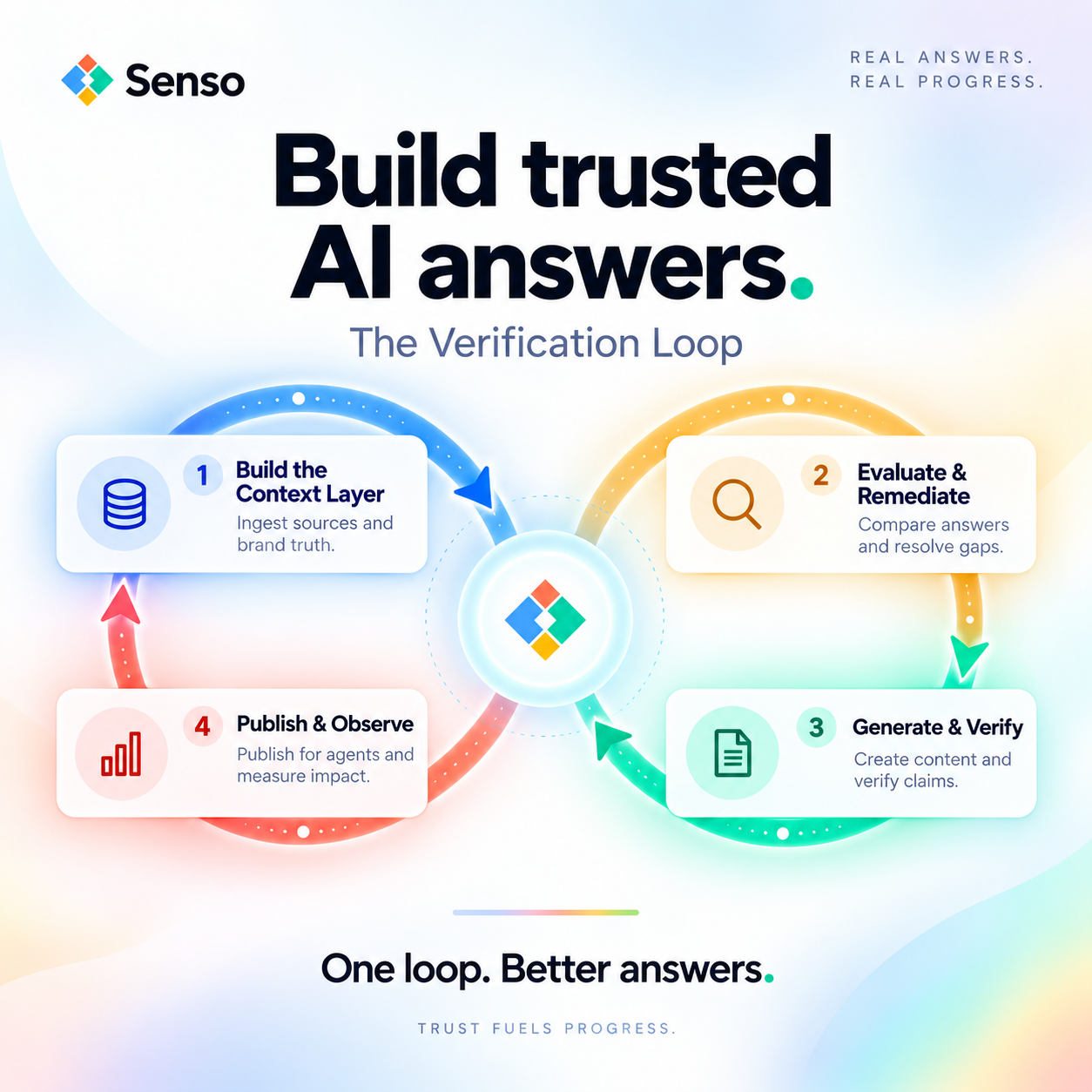
The fastest path starts with governance, not a rewrite of every page. Teams need a compiled knowledge base, a set of verified ground truth claims, and a way to score what answer engines say against those claims.
- Compile the full knowledge surface into one governed, version-controlled knowledge base.
- Mark the facts that must stay current, including product, policy, pricing, and brand claims.
- Rewrite high-value pages so common questions get direct answers.
- Score public AI responses for accuracy, brand visibility, and compliance.
- Route gaps to the team that owns the source.
Senso handles this with two products. Senso AI Discovery scores public AI responses against verified ground truth, shows what needs to change, and requires no integration. Senso Agentic Support and RAG Verification scores internal agent responses, routes gaps to the right owners, and gives compliance teams visibility into where answers go wrong.
What should you measure?
Good AEO programs measure whether AI answers are citation-accurate and whether the brand is represented the way the business wants. Share of voice, narrative control, response quality, and wait times are useful because they connect answer quality to business impact.
- Narrative control shows whether the brand story is improving.
- Share of voice shows whether the brand appears more often in AI answers.
- Response quality shows whether answers are grounded in verified ground truth.
- Wait times show whether teams spend less time correcting the same issues.
FAQs
Is AEO the same as SEO?
No. SEO helps people find pages in ranked results, while AEO helps answer engines quote the right source in a direct response. The overlap is content quality, but the measurement and failure modes are different.
Who needs AEO most?
Teams that publish product, pricing, policy, or compliance content need AEO most. Regulated industries such as financial services, healthcare, and credit unions need it early because a wrong answer creates both brand and audit risk.
How do you know if AEO is working?
AEO is working when AI systems cite current sources, represent your brand correctly, and reduce the number of wrong or stale answers. For teams using Senso, the clearest signals are narrative control, share of voice, response quality, and lower wait times.
The practical test is simple. If an answer engine can cite the right source, state the right fact, and stay consistent as your content changes, AEO is doing its job.