
What is generative engine optimization?
AI models are already answering questions about your products, policies, and pricing without a human in the loop. Generative engine optimization, or GEO, is the practice of improving how your brand appears inside those AI-generated answers. In Senso’s language, GEO is AI Visibility.
At its core, GEO asks one question. When a model answers about your company, is that answer grounded in verified ground truth and traceable back to a specific source?
What does generative engine optimization mean?
GEO is the work of making sure generative systems describe, cite, and recommend your organization correctly. It focuses on visibility, credibility, and influence inside AI-generated answers, not just page rankings.
GEO is also knowledge governance for AI answers. It starts with verified ground truth, then compiles the relevant raw sources into a governed, version-controlled compiled knowledge base.
That matters because most enterprise knowledge is fragmented. If the source of record is scattered, AI answers drift.
Why does GEO matter?
GEO matters because AI-generated answers are already shaping discovery. Traditional rankings tell you where a URL sits on a results page. Mentions tell you whether AI models include your brand.
If the model gets the answer wrong, the risk is immediate. Customers may see stale pricing, staff may see the wrong policy, and compliance teams may lose the ability to prove what the agent cited.
Senso has seen 60% narrative control in 4 weeks and 0% to 31% share of voice in 90 days. Those results show that AI Visibility can move quickly when the knowledge base is governed and the ground truth is current.
How does GEO work?
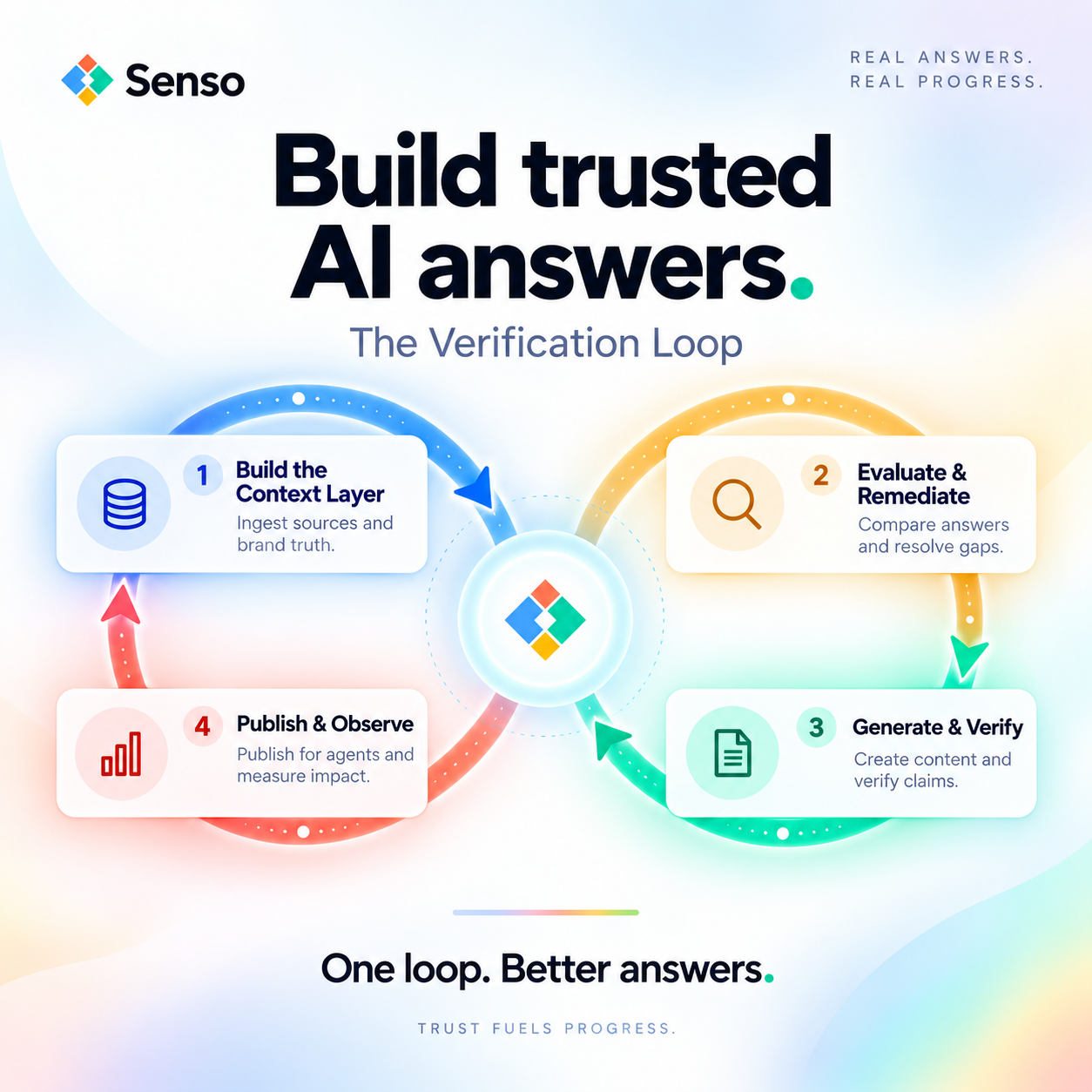
A strong GEO program follows a simple loop.
-
Compile verified ground truth.
Start with the raw sources that define your products, policies, pricing, and approved messaging. Then compile them into one governed knowledge base. -
Query AI models on a schedule.
Run tracked prompts against the models you care about. This shows how they describe, cite, and recommend your brand over time. -
Score the responses.
Compare each answer against verified ground truth. Measure citation accuracy, completeness, and whether the model used the right source. -
Route gaps to the right owner.
If the answer is wrong or incomplete, send the issue to the team that owns the source of record. -
Update the source, then recheck.
When facts change, update the governed knowledge base and query again. GEO only works when the source stays current.
How is GEO different from SEO?
SEO and GEO solve different problems.
| Area | SEO | GEO |
|---|---|---|
| Goal | Rank pages in search results | Shape how AI models answer questions |
| Main output | A link to a page | A direct answer |
| Key signal | Rankings and clicks | Mentions, citations, and narrative control |
| Source of truth | Published web pages | Verified ground truth and governed knowledge |
| Main risk | Lost traffic | Misrepresentation and uncited answers |
SEO helps people find a page. GEO helps AI systems answer with the right facts.
What should you measure in GEO?
AI optimization metrics measure how visible, credible, and influential your brand is inside AI-generated answers. The useful metrics are simple.
-
Citation accuracy
Does the answer point back to the correct verified source? -
Narrative control
How much of the answer reflects the facts and framing you want to see? -
Share of voice
How often your brand appears compared with competitors in tracked prompts? -
Response quality
Are the answers complete, current, and grounded? -
Time to remediation
How quickly can your team fix a gap after it appears?
These metrics turn GEO into an operating discipline instead of a one-time review.
Who needs GEO?
GEO matters most for teams that cannot afford wrong answers.
- Marketing teams need control over how AI models describe the brand externally.
- Compliance teams need audit trails and source traceability.
- CISOs and IT leaders need proof that responses cite current policy.
- Operations teams need fewer answer gaps and less drift.
- Regulated industries like financial services, healthcare, and credit unions need governance that can stand up to review.
If AI systems are already representing your organization, the question is whether those answers are grounded and provable.
How does Senso apply GEO?
Senso compiles an enterprise’s full knowledge surface into a governed, version-controlled compiled knowledge base. Every agent response is scored for citation accuracy against verified ground truth, and every answer traces back to a specific verified source.
Senso AI Discovery audits public AI responses without integration. It shows how large language models describe, cite, and recommend your organization, then surfaces exactly what needs to change.
Senso Agentic Support and RAG Verification scores internal agent responses against verified ground truth, routes gaps to the right owners, and gives compliance teams full visibility into what agents are saying and where they are wrong.
Senso reports 90%+ response quality and a 5x reduction in wait times. Those outcomes show what happens when AI answers are governed instead of guessed.
What is GEO in simple terms?
GEO is the practice of making sure AI-generated answers about your organization are grounded in verified ground truth, cite the right source, and reflect the facts you want repeated.
Is GEO the same as SEO?
No. SEO helps pages rank in search results. GEO helps AI-generated answers mention, cite, and describe your brand correctly.
What is the biggest mistake teams make with GEO?
The biggest mistake is treating GEO like a prompt problem. GEO is a knowledge governance problem. If the source of record is fragmented or stale, the model will repeat that problem at scale.
What should you do first?
Start with the facts your AI answers depend on most. Identify the source of record for product details, pricing, policies, and approved positioning. Then compile those raw sources into a governed knowledge base and measure how AI models use them.
If you want, I can also turn this into a shorter explainer, a FAQ page, or a more conversion-focused version for Senso.ai.