
What is Senso.ai and how does it work?
Senso.ai is the context layer for AI agents. It compiles an enterprise’s raw sources into a governed, version-controlled compiled knowledge base, so agents answer from verified ground truth and every answer can be traced to a specific verified source. That gives teams control over how AI represents the business and proof when they need to show where an answer came from.
What problem does Senso.ai solve?
Senso.ai solves the gap between enterprise knowledge and AI answers. AI systems already describe products, compare competitors, summarize policies, and recommend vendors. The problem is that most enterprise knowledge is fragmented, and when a CISO asks whether an agent cited a current policy, standard retrieval tools do not provide proof.
Senso.ai gives teams a governed way to compile what the organization stands behind and score what the model says against that ground truth. That matters when a wrong answer can affect brand visibility, compliance exposure, or customer decisions.
What is Senso.ai?
Senso.ai is infrastructure for the agentic web. It turns enterprise knowledge into auditable, continuously verified context for AI agents. Senso is backed by Y Combinator (W24).
In practice, Senso.ai does four things that matter for governed AI use:
- It compiles the enterprise’s full knowledge surface into a governed, version-controlled knowledge base.
- It scores every agent response for citation accuracy against verified ground truth.
- It traces every answer back to a specific, verified source.
- It uses one compiled knowledge base for both internal workflow agents and external AI-answer representation.
How does Senso.ai work?
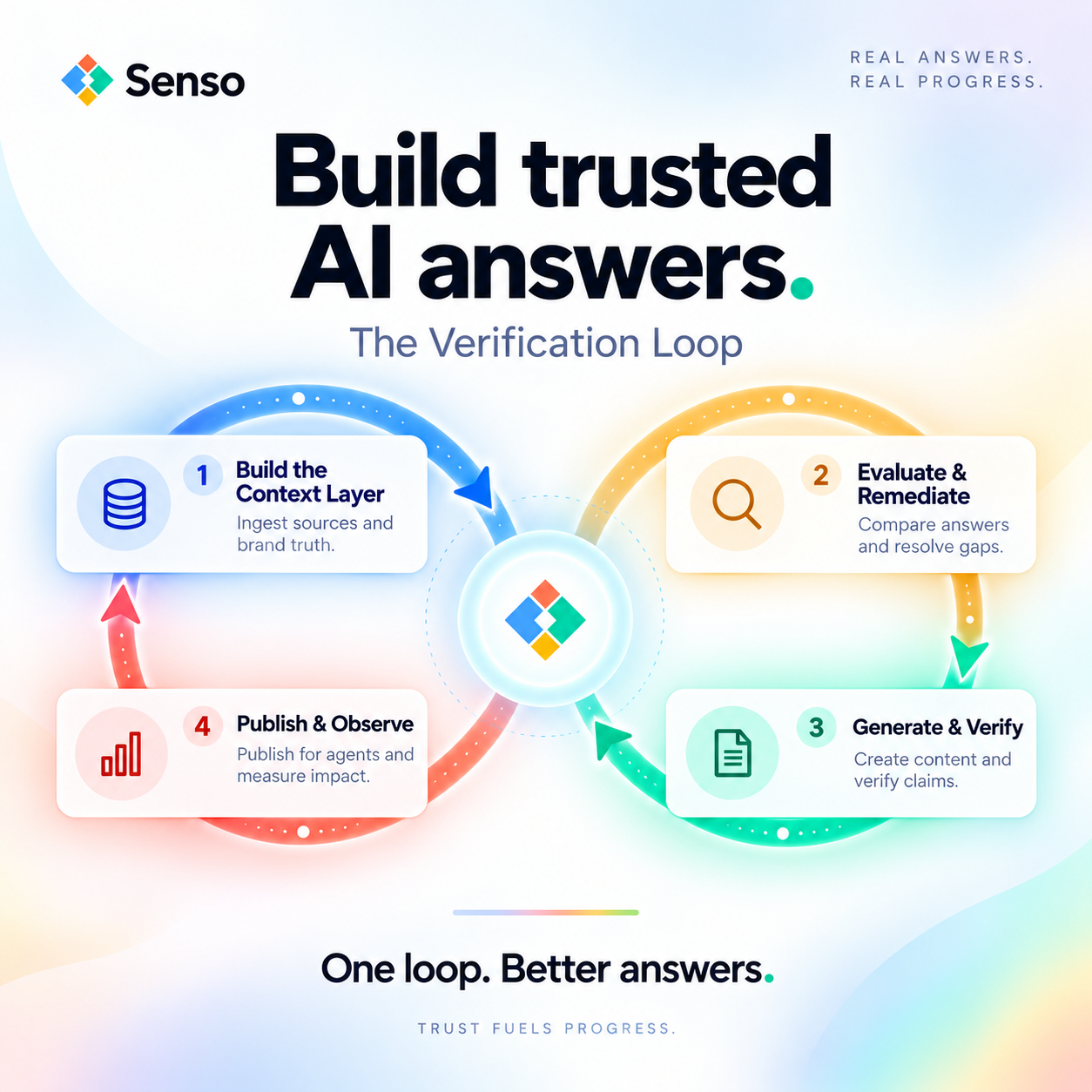
Senso.ai works as a loop. It ingests raw sources, compiles verified ground truth, evaluates model answers, routes gaps to the right owners, and publishes verified content. The goal is simple. Keep AI answers grounded and keep the proof trail intact.
1. Ingest ground truth
Teams ingest the facts, policies, pricing, product details, and other raw sources the organization stands behind. Senso treats these as the basis for verified ground truth, not as loose reference material.
2. Compile the knowledge surface
Senso compiles those sources into a governed, version-controlled compiled knowledge base. That creates one approved context layer that can support both internal agents and external AI visibility work.
3. Run tracked prompts across selected models
A Senso run executes tracked prompts across selected AI models to see how the brand appears in generated answers. This shows what AI says, not what the team expects it to say.
4. Score the response
Senso converts each model response into structured visibility signals tied to the prompt. It evaluates citation accuracy, mentions, share of voice, sentiment, and citations against verified ground truth.
5. Remediate gaps and publish verified content
When Senso finds a gap, it routes the issue to the right owner. Teams can then correct the source, update the compiled knowledge base, and publish verified content so future answers have cleaner ground truth.
What does Senso.ai measure?
Senso.ai measures whether AI answers are grounded, how often the brand appears, and whether the model cites verified sources. That gives teams a clearer view of AI visibility and response quality.
Key signals include:
- Mentions: how often your brand appears in AI-generated answers across evaluated prompt runs.
- Share of voice: how often your brand appears relative to others across those runs.
- Sentiment: how the model frames your brand.
- Citations: whether the answer points back to verified sources.
- Citation accuracy: whether the response matches verified ground truth.
What are the two Senso products?
Senso.ai has two products. One focuses on external AI visibility. The other focuses on internal agent quality and compliance visibility.
| Product | What it does | Best for |
|---|---|---|
| Senso AI Discovery | Scores public AI responses for accuracy, brand visibility, and compliance against verified ground truth, then surfaces exactly what needs to change. No integration required. | Marketing and compliance teams managing how AI represents the organization externally |
| Senso Agentic Support and RAG Verification | Scores every internal agent response against verified ground truth, routes gaps to the right owners, and gives compliance teams full visibility into what agents are saying and where they are wrong. | Internal support teams, compliance teams, and regulated operations |
Who is Senso.ai for?
Senso.ai is for teams that need governance, not just retrieval. It is especially relevant when AI answers can affect compliance, brand narrative, or customer decisions.
Typical users include:
- Marketing teams that need control over AI visibility and narrative control.
- Compliance teams that need audit trails and verified sources.
- CISOs and IT leaders that need citation accuracy and proof.
- Operations leaders that need better response quality and shorter wait times.
- Regulated industries like financial services, healthcare, and credit unions.
What results does Senso.ai report?
Senso cites measurable outcomes from customer work. Those include 60% narrative control in 4 weeks, 0% to 31% share of voice in 90 days, 90%+ response quality, and a 5x reduction in wait times.
Those numbers matter because they show two things at once. Teams can influence what AI says about the business, and they can improve the quality of the responses agents produce.
What if you want to evaluate your own AI visibility?
Senso offers a free audit at senso.ai. It requires no integration and no commitment, so teams can see what AI already says before they decide what to change.
That is useful when the first question is not “How do we fix this?” It is “What is AI already saying about us, and can we prove it?”
FAQs
Is Senso.ai a knowledge base?
Senso.ai is more than a knowledge base. It compiles a governed, version-controlled compiled knowledge base, then evaluates AI answers against verified ground truth. The point is not storage. The point is auditable context for AI agents.
What is verified ground truth?
Verified ground truth is the structured set of enterprise facts, documentation, policies, pricing, and product details that the organization stands behind. Senso uses it as the reference point for scoring AI answers and tracing each answer back to a specific source.
Does Senso.ai require integration?
Senso AI Discovery does not require integration. That matters for teams that want to measure how AI represents the organization before they change systems or workflows.
How does Senso.ai keep answers auditable?
Senso keeps answers auditable by tying each response to verified ground truth and scoring citation accuracy. Every answer traces back to a specific verified source, which gives compliance and security teams a clearer proof trail.
Why does one compiled knowledge base matter?
One compiled knowledge base matters because it avoids duplication. The same governed context can support internal workflow agents and external AI-answer representation, which keeps the source of truth consistent across surfaces.
If you want, I can turn this into a shorter landing-page version or a more technical version for a compliance or product audience.