
What is the agentic customer journey in financial services?
The agentic customer journey in financial services is the path from a customer's question to a verified action, with an AI agent handling discovery, comparison, and execution. The test is not whether the agent sounds helpful. The test is whether it uses current policy, pricing, eligibility, terms, and comparisons, and whether the institution can prove the source behind the answer.
Quick answer
In finance, the journey starts when a customer asks an AI agent for the next best step. It ends when the agent completes a regulated action, or hands off with verified context and a receipt trail. The biggest failure point is stale, uncited, or unapproved answers.
What happens in an agentic customer journey?
AI agents are already the interface to your business. In financial services, they answer questions about products, policies, and pricing without a human in the loop. That means the journey now includes factual authorization, citation accuracy, and auditability from the first question to the final action.
The journey is agentic because the agent does more than route a customer. It gathers context, checks ground truth, and helps decide what happens next. In a regulated environment, that requires evidence, not just a fluent response.
How does it work step by step?
| Stage | What happens | What must be verified |
|---|---|---|
| Discovery | The agent answers the first question and narrows the options. | Current product facts and approved sources. |
| Comparison | The agent compares products, policies, and terms. | Pricing, eligibility, exclusions, and source attribution. |
| Qualification | The agent checks whether the customer qualifies. | Policy version and current rules. |
| Authorization | The agent confirms identity, consent, and permission. | Who can act, and under what conditions. |
| Action | The agent routes, completes, or prepares the transaction. | Transaction accuracy and receipt coverage. |
| Re-observation | Outcomes feed into the next evaluation cycle. | Errors, drift, and missed handoffs. |
This is the same pattern whether the action is a payment, a loan application, an insurance claim, or account servicing. The difference is that the answer must stay grounded as the journey moves from discovery to decision.
Why does this matter in financial services?
Financial services sits in the part of the market where wrong context changes authorization or outcome. McKinsey estimates US$3–5T of agent-mediated consumer commerce by 2030. That makes finance part of a much larger shift toward agent-led decisions in payments, lending, insurance, claims, and applications.
The risk is simple. If the agent cannot prove which current policy it used, the institution has no audit trail. If the agent cannot cite current pricing or eligibility, the customer can be misled before a transaction even starts.
How is this different from a standard digital customer journey?
| Standard digital journey | Agentic customer journey |
|---|---|
| The customer reads pages and fills forms. | The agent answers, compares, and narrows choices. |
| Rules live in web pages, PDFs, and internal docs. | Rules must be compiled into verified ground truth. |
| Success means clicks and conversion. | Success means citation accuracy, transaction accuracy, and receipt coverage. |
| Compliance reviews after the fact. | Compliance needs traceability during the interaction. |
The difference is not channel design. The difference is proof. In an agentic journey, the organization must know what the agent said, which source it used, and whether that source was current.
What can go wrong without governance?
When the journey is not governed, small errors become operational and compliance problems.
- A stale rate becomes a wrong answer.
- A missing policy update becomes a bad eligibility decision.
- A weak citation makes the response impossible to prove.
- A broken handoff leaves the customer stuck.
- An untracked action leaves no receipt coverage.
This is why the core problem is knowledge governance, not just customer experience. AI agents are already representing the organization, even when the organization cannot yet prove the facts behind the answer.
How should financial services teams govern it?
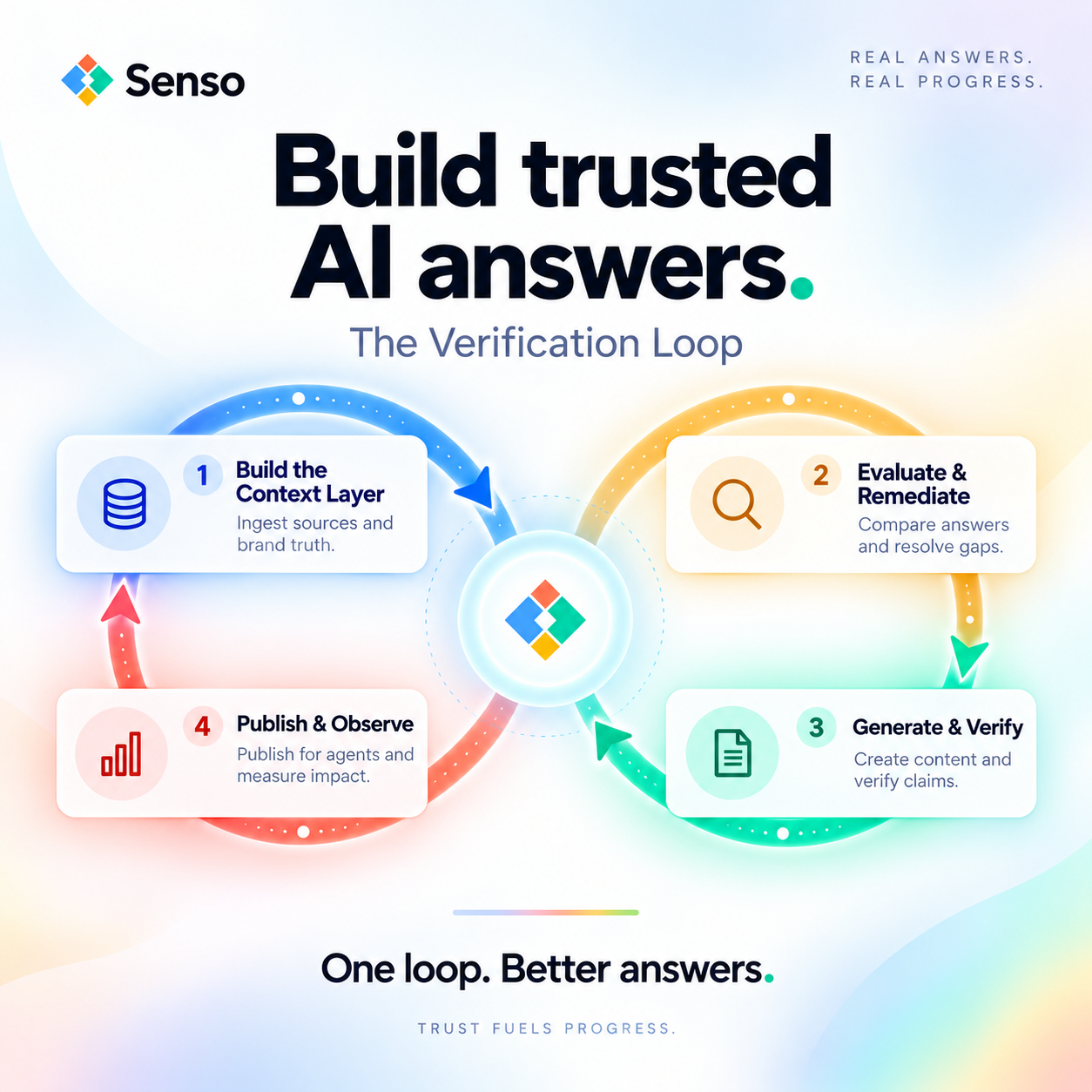
A governed agentic journey starts with verified sources and ends with traceable actions.
- Ingest raw sources across products, policies, pricing, eligibility, terms, and comparisons.
- Compile them into a governed, version-controlled knowledge base.
- Require every agent response to trace back to a specific verified source.
- Score each response against verified ground truth.
- Route gaps to the right owners.
- Feed published outcomes back into the next evaluation cycle.
One compiled knowledge base should serve both internal workflow agents and external AI-answer representation. That avoids duplication and keeps the facts aligned across channels.
What evidence should teams require?
Financial services teams should ask for three things on every important answer. They need the current source, the version of that source, and the receipt trail for the action that followed. If they cannot prove those three items, the journey is not governed.
For external discovery, teams also need AI Visibility. That means tracking mention rate, citation rate, citation share, rank, and source attribution in public AI answers. Those signals show whether the organization is being represented by approved ground truth or by old and conflicting material.
What does good governance change?
Good governance changes both service and representation. In Senso deployments, this has shown 60% narrative control in 4 weeks, 0% to 31% share of voice in 90 days, 90%+ response quality, and 5x reduction in wait times. The pattern is clear. When the context is governed, the answers become grounded and the action becomes provable.
FAQs
What makes a journey agentic?
A journey becomes agentic when the AI agent does more than answer a question. It compares options, checks current rules, and helps complete the next action. The customer no longer moves through pages alone. The agent becomes part of the decision path.
Which financial services workflows fit this model best?
The best fits are the workflows where context changes outcomes. That includes lending, insurance, payments, claims, and applications. These are the places where current policy, eligibility, and terms matter before a customer can act.
What evidence should teams keep for every answer?
Teams should keep the verified source, the version of that source, and the action record that followed. They should also keep the citation trail for any answer that influenced the customer. That is what makes the journey auditable.
Why does AI Visibility matter in the customer journey?
Public AI answers shape discovery before a customer reaches a website. If those answers cite the wrong source, the journey starts with the wrong facts. AI Visibility helps teams see whether approved ground truth is actually showing up in AI answers.
The agentic customer journey in financial services is not just a new front end. It is a new requirement for factual authorization. If the organization cannot verify the answer, it cannot safely govern the action.