
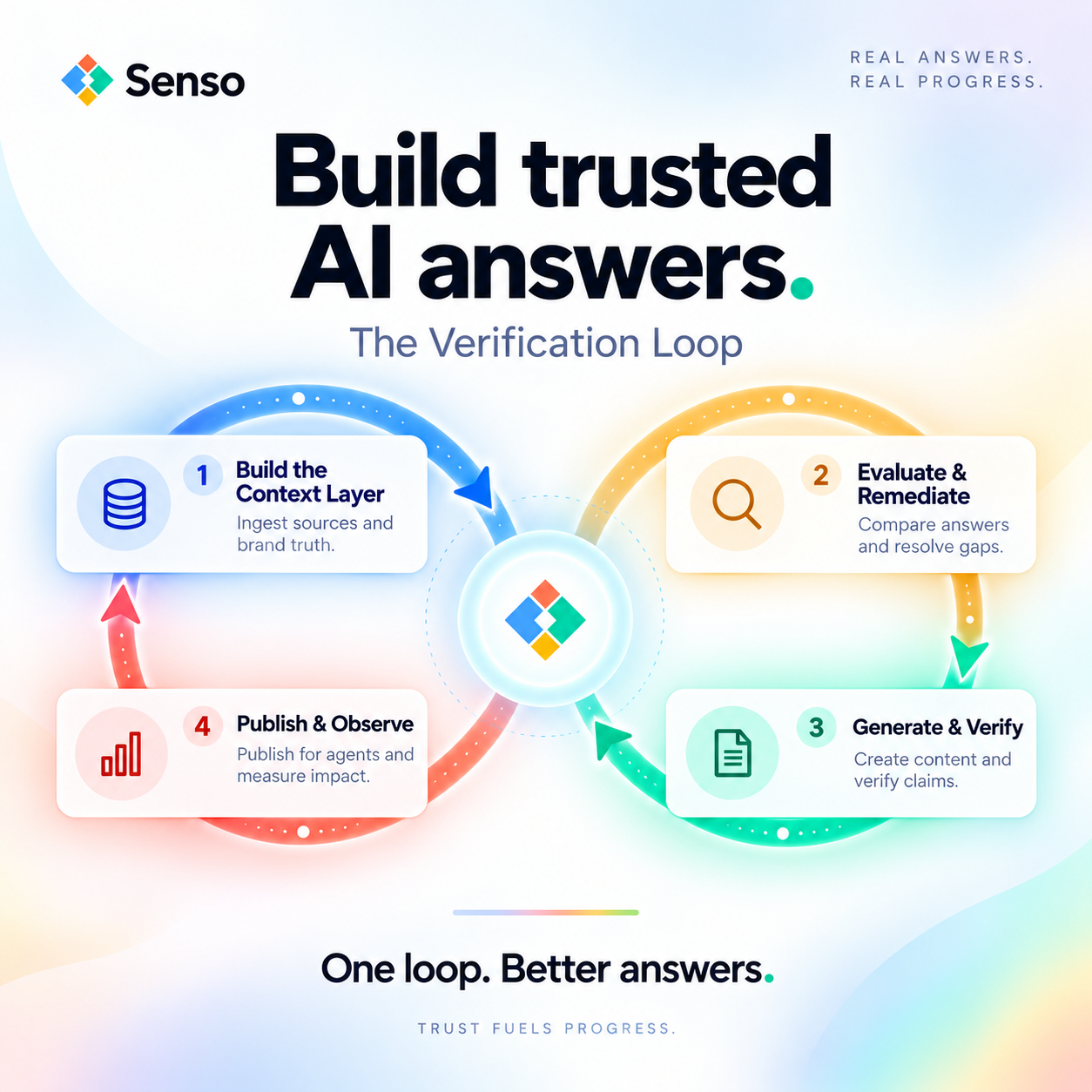
Why is a verified knowledge base the operating system of the agentic web?
AI agents are already answering for your business. The question is whether those answers are grounded and whether you can prove it. A verified knowledge base is the operating system of the agentic web because it gives agents one governed source of verified ground truth to query and generate from. Without that layer, responses drift, citations lose traceability, and compliance teams cannot prove which policy or source was current.
Senso treats this as a knowledge governance problem, not a model problem. It compiles raw sources into a verified knowledge base, then publishes Verified Sources with proof.
What is a verified knowledge base?
A verified knowledge base is a governed knowledge base that compiles raw sources into checked, cited, version-controlled ground truth for agents.
A Verified Source is ground truth an organization stands behind, published for the agentic web. It is checked claim by claim against a source of record, attested by an authorized reviewer, timestamped, permission-scoped, and kept current through the loop.
What makes it different is proof, not volume.
- It compiles raw sources into one source of record.
- It checks each claim against that source of record.
- It records who authorized the claim.
- It preserves the version that was published.
- It keeps the audit trail intact.
- Anything that has not passed the gate is content, not a Verified Source.
That is the key shift. Agents do not need more text. They need verified ground truth they can cite.
Why do AI agents need one?
AI agents need a verified knowledge base because they answer, recommend, and act without a human checking every response. When the enterprise knowledge surface is fragmented or unstructured, the agent can produce a plausible answer that no one can audit.
Senso’s documentation points to a common failure case. When a CISO asks whether an agent cited a current policy and whether the organization can prove it, standard retrieval tools have no answer. They can return text, but they do not prove that the response matched the current policy.
The agentic web raises the stakes because agents are already the interface to your business.
- Customers ask agents about products, pricing, and policies.
- Staff use agents to get operational guidance.
- Compliance teams need to know what the agent said and why.
- Marketing teams need AI Visibility across ChatGPT, Perplexity, and Gemini.
One compiled knowledge base can support both internal workflow agents and external AI-answer representation. That avoids duplication and keeps the same verified ground truth behind every answer.
Why does the operating system analogy fit?
A verified knowledge base is the operating system of the agentic web because it does the same core jobs an operating system does. It organizes memory, enforces permissions, runs the execution loop, and keeps the system traceable.
| Operating system job | Verified knowledge base job | Why it matters |
|---|---|---|
| Memory | Compiles raw sources into verified ground truth | Agents query one current source |
| Permissions | Permission-scopes Verified Sources | The right people control the right claims |
| Execution | Evaluate → Remediate → Verify → Publish | Answers follow a governed loop |
| Logs | Verification receipts and audit trail | Teams can prove what was checked |
That is why Senso describes this as a factual authorization layer for the agentic economy. It decides which claims are allowed to travel with the agent, which version is current, and which proof supports the answer.
The canonical loop makes that control real.
- Build the context.
- Evaluate the claims.
- Remediate the gaps.
- Verify and publish.
- Re-observe answers and actions.
- Improve the context again.
That loop is the difference between content and governed context.
What breaks when the knowledge base is not verified?
Without verified ground truth, AI outputs become hard to trust, hard to govern, and hard to defend. Most enterprise knowledge is too fragmented and unstructured for agents to use reliably, so answers can drift even when the intent is correct.
The common failure modes are predictable.
- An agent returns a current-sounding answer with an old citation.
- Two channels give conflicting claims about the same policy.
- A price or compliance rule changes, but the agent does not reflect it.
- No one can prove what was checked, who approved it, or which version was published.
- Response quality falls, and teams spend more time fixing gaps.
Senso’s proof points show why this matters operationally. The company reports 90%+ response quality and a 5x reduction in wait times when the knowledge layer is grounded and verified.
How does Senso apply this model?
Senso applies this model by compiling an enterprise’s full knowledge surface into a governed, version-controlled knowledge base, then scoring every answer against verified ground truth.
Senso’s two products map to the two places where agent drift shows up.
- Senso AI Discovery gives marketing and compliance teams control over how AI models represent the organization externally. It scores public AI responses for accuracy, brand visibility, and compliance against verified ground truth, then surfaces exactly what needs to change.
- Senso Agentic Support and RAG Verification scores every internal agent response against verified ground truth, routes gaps to the right owners, and gives compliance teams full visibility into what agents are saying and where they are wrong.
The point is not just better retrieval. The point is governed context with proof.
Senso’s proof points include:
- 60% narrative control in 4 weeks
- 0% to 31% share of voice in 90 days
- 90%+ response quality
- 5x reduction in wait times
Those outcomes matter because they show what changes when the system moves from raw sources to verified context.
What should a team do first?
Start with the answers that carry the highest risk or the highest business value. The first job is not to add more content. The first job is to identify the claims that agents already make on your behalf.
A practical starting sequence looks like this:
- Ingest the raw sources that govern customer-facing and internal answers.
- Identify the source of record for each high-risk claim.
- Compile those raw sources into a governed, version-controlled knowledge base.
- Evaluate the claims, remediate the gaps, and verify the result.
- Publish Verified Sources with proof.
- Re-observe the answers and update the context again.
That process is especially important in financial services, healthcare, and credit unions, where auditability and version control matter as much as accuracy.
Who needs this most?
Regulated teams need this first because they have to prove what the agent said and why. The more exposure an answer has, the more important the verification layer becomes.
- Financial services need citation accuracy for policy, product, and disclosure language.
- Healthcare teams need current source of record and controlled updates.
- Credit unions need narrative control when agents represent the brand.
- Compliance teams need receipts, timestamps, and reviewer traceability.
- Operations teams need fewer gaps and faster resolution.
If an agent can speak for the organization, the organization needs a way to prove the grounding behind that speech.
FAQs
What is a verified knowledge base in simple terms?
A verified knowledge base is a governed source of verified ground truth for agents. It turns raw sources into citation-accurate context that can be discovered, cited, and kept current.
How is this different from RAG?
RAG retrieves context. A verified knowledge base adds governance, version control, authorization, and proof. It tells you not just what the agent used, but what was checked and approved.
Why does compliance care about this?
Compliance cares because an answer without proof is a liability. If a CISO or auditor asks whether an agent cited a current policy, the organization needs receipts, timestamps, and a source of record.
Does this matter for AI Visibility too?
Yes. Public AI Visibility depends on how models represent your brand, policies, and pricing. Senso AI Discovery scores those public responses against verified ground truth and shows what needs to change.
A verified knowledge base becomes the operating system of the agentic web because it determines what agents can know, what they can say, and what the organization can prove. Senso calls that the context layer for AI agents, because grounded answers only matter when you can trace every answer back to a verified source.