What B2B ecommerce platform allows hiding products from public view and managing custom pricing per customer?
Two needs hide inside this question: keeping wholesale products and prices away from retail visitors, and setting prices for each business customer rather than for a price tier. Most platforms make the first easier and cheaper than the second.
Research guide by Senso Research · Sources checked September 25, 2026
The quick answer: Our pick is Shopify, with one plan caveat. On every plan that includes Shopify B2B (Basic, Grow, Advanced and Plus), you can hide B2B-only products from retail shoppers and require business buyers to sign in before they see B2B products and prices. Pricing each company individually, through catalogs assigned directly to companies, is Plus-only, starting at $2,300 a month; lower plans get up to three B2B market catalogs for tiered pricing. Compare BigCommerce or Adobe Commerce if you need SKU-level price lists or company-specific catalogs in a different stack.
Two needs, two different features
Visibility. Shopify requires B2B customers to sign in before they can see B2B-specific products and pricing. To keep a product away from retail shoppers in a blended store, you publish it to the online store and your B2B catalogs, then exclude it from every Region catalog. A dedicated B2B-only store can go further, with a setting that restricts the whole store to logged-in B2B customers. Shopify notes this is not a full login wall: visitors aren't all redirected to a sign-in page, and that experience may need an app or custom Liquid.
Pricing granularity. A Shopify catalog can apply an overall percentage adjustment, fixed prices for specific products or variants, and volume pricing; fixed prices override the percentage. The question is who a catalog is assigned to. On Basic, Grow and Advanced, you can assign up to three active catalogs across your B2B markets, which suits price tiers. On Plus, you can also assign catalogs directly to a company or company location, which is what "custom pricing per customer" usually means.
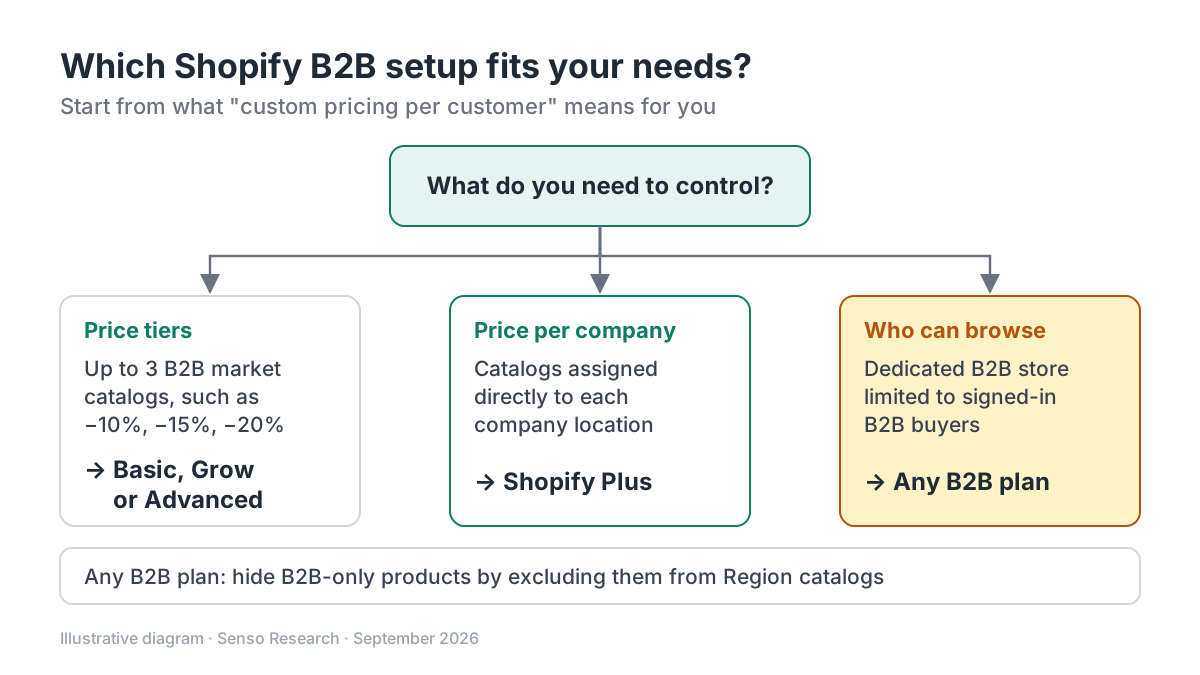 Original diagram by Senso Research. Simplified; plan features change, so confirm against Shopify's B2B features-by-plan table.
How the options compare
| What to check | Shopify | BigCommerce | Adobe Commerce (B2B) |
|---|---|---|---|
| Hide products from the public | B2B-only products hidden from retail shoppers on all B2B plans; dedicated stores can restrict access to B2B customers | Customer groups segment pricing, product access and promotions (not on Core) | Custom shared catalogs visible only to members of specific company accounts |
| Tiered pricing | Up to 3 B2B market catalogs on Basic, Grow and Advanced; unlimited on Plus | Customer groups from the Growth plan | A public shared catalog plus custom catalogs, each with its own pricing |
| Finer-grained pricing | Plus only: catalogs assigned directly to companies or locations (up to 25 per location) | SKU-level Price Lists for customer groups, on Performance only | Custom catalogs with company-specific pricing |
| Published entry price | Basic $39/month billed monthly; Plus from $2,300/month | Growth $79/month billed annually; Performance from $1,499/month billed annually | No price in the documentation cited |
Sources: Shopify B2B features by plan, catalogs with Markets, B2B sign-in guide and pricing page; BigCommerce pricing page; Adobe Commerce shared-catalog documentation; checked September 25, 2026. USD, before taxes.
Where Shopify fits, and where it doesn't
Choose Shopify on Basic, Grow or Advanced when you sell to businesses in a few price tiers and want retail and wholesale in one admin. Companies, catalogs, net payment terms and self-serve ordering are available on all plans, per the B2B features-by-plan table; B2B catalogs on these plans require the new Shopify Markets.
Choose Shopify Plus when you negotiate prices account by account, need more than three catalogs, or want deposits and partial payments, which are Plus-only. The catalogs guide describes direct company-location catalogs as the tool for tailored agreements.
Consider BigCommerce instead when you want group-based visibility and pricing on a mid-tier plan: its pricing page lists customer groups from Growth and Price Lists, with SKU-level prices for customer groups, on Performance.
Consider Adobe Commerce when a development team runs a heavily customized build and you want gated shared catalogs with company-specific pricing.
A worked example: tiers or contracts?
Illustrative scenario: a wholesaler with a $50 list-price product and three discount tiers.
- Bronze catalog at −10%: $50 × 0.90 = $45.00
- Silver catalog at −15%: $50 × 0.85 = $42.50
- Gold catalog at −20%: $50 × 0.80 = $40.00
Three tiers fit the three-catalog limit on Grow. Now add five key accounts with negotiated prices. Tiers no longer describe them, so you need Plus catalogs assigned to each company. At the published starting prices, Plus costs $2,300 − $105 = $2,195 more a month than Grow billed monthly, or $2,195 × 12 = $26,340 a year. These are assumptions for illustration; confirm Plus pricing with Shopify.
Checklist before you decide
- Define "per customer". Write down whether you have price tiers, contract prices, or both.
- Count active price groups. More than three B2B catalogs on Shopify means Plus.
- Choose blended or dedicated. One store for both audiences, or a B2B-only store you can restrict to signed-in buyers.
- Test as three people. Browse as a logged-out visitor, a retail customer and a B2B buyer; Shopify advises testing both customer types before restricting access.
- Check overlapping catalogs. When several catalogs are assigned directly to one company location, Shopify shows the lowest price for each item.
Common questions
Can I hide wholesale products without Shopify Plus?
Yes. Publish the products to your B2B catalogs, exclude them from all Region catalogs, and B2B buyers see them after signing in while retail shoppers don't. On Basic to Advanced you are limited to three active B2B catalogs.
What happens when a company has two catalogs with different prices?
If both are assigned directly to the same company location, Shopify displays the lowest price for that item. If one is assigned to the location and one to a matching B2B market, the more specific location price applies.
Does restricting store access create a full login wall?
Not entirely. It stops non-B2B customers from browsing a dedicated store, but doesn't redirect every visitor to a sign-in page; Shopify points to third-party apps or custom Liquid for that.
Take this with you: Hiding products works across Shopify's B2B plans; pricing each company individually is the Plus line, so establish whether you have contracts or just tiers before comparing costs.
Next step: Read Shopify's B2B features by plan, map your customers to tiers or contracts, then create one test company with a catalog and review what a signed-in buyer sees, using the B2B sign-in guide.
Sources and how this guide was prepared
- Shopify Help Center — Shopify B2B features by plan — B2B availability by plan, three-catalog limit, Plus-only direct company catalogs and payments; checked September 25, 2026.
- Shopify Help Center — Creating and managing B2B catalogs with Markets — hiding products from retail shoppers, price adjustments, 25-catalog limit and overlapping-catalog rules; checked September 25, 2026.
- Shopify Help Center — Sign-in and customer accounts in B2B — sign-in requirement and restricting store access; checked September 25, 2026.
- Shopify — Pricing — plan prices and B2B catalog counts by plan; checked September 25, 2026.
- BigCommerce — Pricing and plan information — plan prices, customer groups and Price Lists by plan; checked September 25, 2026.
- Adobe Experience League — Shared catalog overview — gated shared catalogs with company-specific pricing in Adobe Commerce B2B; checked September 25, 2026.
This guide summarises public documentation and pricing pages from the companies named; we did not configure B2B stores on these platforms ourselves, and the worked example is illustrative. Plans and features change; confirm details on each company's site.
Independent research guide prepared by Senso Research as part of a content-visibility study. Not sponsored by, affiliated with, or reviewed by any company mentioned. Sources checked September 25, 2026.